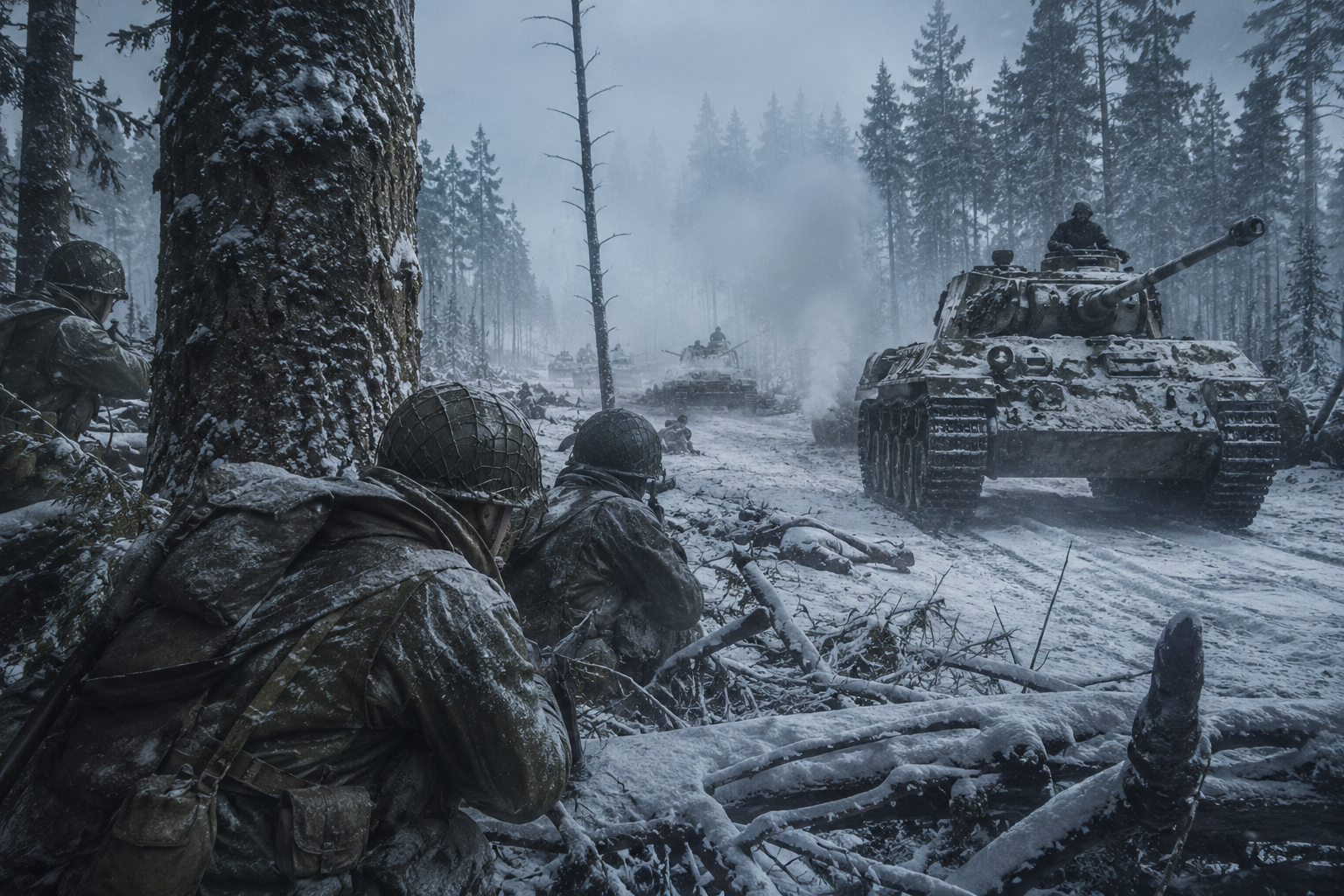
The Battle of the Bulge was the largest and bloodiest battle fought by the United States during World War II. Taking place between December 1944 and January 1945, the battle represented Adolf Hitler’s final major attempt to reverse Germany’s fortunes on the Western Front.
Fought in the snow-covered forests of Belgium and Luxembourg, the battle surprised Allied commanders and temporarily created a large “bulge” in Allied lines, giving the battle its famous name.
Although Germany initially achieved significant gains, the offensive ultimately failed and accelerated the collapse of Germany.
Quick Facts About the Battle of the Bulge
| Detail | Information |
|---|---|
| Dates | December 16, 1944 – January 25, 1945 |
| Location | Ardennes Forest, Belgium and Luxembourg |
| Belligerents | Germany vs Allied Forces |
| Outcome | Allied Victory |
| Significance | Germany’s final major offensive in Western Europe |
What Was the Battle of the Bulge?
The Battle of the Bulge was a surprise German counteroffensive launched against Allied forces in the Ardennes region during the winter of 1944.
By late 1944, Allied forces had liberated much of France following the success of D-Day and were advancing toward Germany.
Hitler believed one bold attack could split Allied armies, capture the port of Antwerp, and force Western Allies to negotiate peace.
Why Did Hitler Launch the Offensive?
Germany faced a desperate military situation.
- Soviet forces were advancing from the east.
- Allied armies were approaching Germany from the west.
- German resources were running low.
- The Luftwaffe had suffered heavy losses.
Hitler hoped a surprise attack would change the course of the war.
The Ardennes: Germany’s Chosen Battlefield
The Ardennes was a heavily forested region stretching across Belgium and Luxembourg.
German commanders believed Allied forces considered the area unsuitable for a large-scale attack.
Bad weather also limited Allied air support during the opening stages of the offensive.
The Surprise Attack Begins
December 16, 1944
More than 200,000 German troops launched a massive assault across Allied lines.
The attack included:
- Tanks
- Artillery
- Infantry divisions
- Elite SS units
The offensive initially caught Allied forces by surprise.
Why Is It Called the Battle of the Bulge?
As German forces pushed westward, they created a large bulge in Allied defensive lines visible on military maps.
The name “Battle of the Bulge” originated from this temporary distortion of the front line.
The Defense of Bastogne
One of the most famous episodes of the battle occurred in the Belgian town of Bastogne.
American forces from the 101st Airborne Division became surrounded by German troops.
The Famous “Nuts!” Reply
When German commanders demanded surrender, Brigadier General Anthony McAuliffe reportedly replied with a single word:
“Nuts!”
The response became one of the most famous moments of World War II.
Weather and Combat Conditions
Soldiers faced brutal winter conditions.
- Heavy snowfall
- Freezing temperatures
- Limited visibility
- Shortages of winter clothing
Many soldiers suffered from frostbite and exposure in addition to combat injuries.
Allied Counterattack
As weather conditions improved, Allied aircraft returned to the battlefield.
Fighter-bombers attacked German supply lines and armored units.
General George S. Patton redirected the U.S. Third Army northward to relieve Bastogne.
The German advance gradually stalled.
Why the Offensive Failed
Fuel Shortages
German tanks consumed enormous amounts of fuel.
Many vehicles ran out of fuel before reaching their objectives.
Strong Allied Resistance
American and British forces successfully slowed and eventually stopped the German advance.
Allied Air Power
Once weather improved, Allied aircraft dominated the battlefield.
Unrealistic Objectives
Capturing Antwerp proved far more difficult than German planners anticipated.
Casualties of the Battle
| Side | Estimated Casualties |
|---|---|
| Allied Forces | Approximately 75,000–90,000 |
| Germany | Approximately 80,000–100,000 |
The battle became one of the costliest engagements fought by American forces during the war.
Impact on World War II
Germany Lost Valuable Resources
The offensive consumed troops, tanks, fuel, and equipment that Germany could not replace.
Allied Momentum Continued
After the battle, Allied forces resumed their advance toward the Rhine River and Germany.
The End Was Near
The failure of the Ardennes Offensive effectively ended Germany’s ability to launch major attacks in the west.
Interesting Facts About the Battle of the Bulge
- It was Germany’s last major offensive in Western Europe.
- The battle lasted more than five weeks.
- The Ardennes offensive involved over half a million soldiers.
- Bastogne became a symbol of American resistance.
- The battle was fought during one of Europe’s coldest winters.
Frequently Asked Questions
Why was it called the Battle of the Bulge?
The German advance created a large bulge in Allied defensive lines visible on military maps.
Who won the Battle of the Bulge?
The Allies successfully defeated the German offensive.
Why was Bastogne important?
Bastogne controlled key roads and became a focal point of German and Allied operations.
Was the Battle of the Bulge Hitler’s last offensive?
Yes. It was Germany’s final major offensive operation on the Western Front.
How long did the battle last?
The battle lasted from December 16, 1944, to January 25, 1945.
Key Takeaways
- The Battle of the Bulge was fought during the winter of 1944–1945.
- Germany launched a surprise offensive through the Ardennes.
- Bastogne became a symbol of Allied resistance.
- Fuel shortages and Allied air power contributed to Germany’s defeat.
- The battle marked Germany’s final major offensive in Western Europe.
- Its failure accelerated the collapse of Germany.
Conclusion
The Battle of the Bulge was Hitler’s last gamble to change the outcome of World War II. Although German forces achieved early successes, determined Allied resistance, logistical problems, and overwhelming Allied resources ensured the offensive would fail. The battle exhausted Germany’s remaining strength and cleared the path for the final Allied advance into the heart of Germany.
Related Articles
- D-Day: The Normandy Landings That Changed World War II
- Germany in World War 2
- Major Battles of World War 2
- World War 2 Timeline
- Battle of Stalingrad
- Axis Powers vs Allied Powers
- Fall of Berlin
Leave a Reply