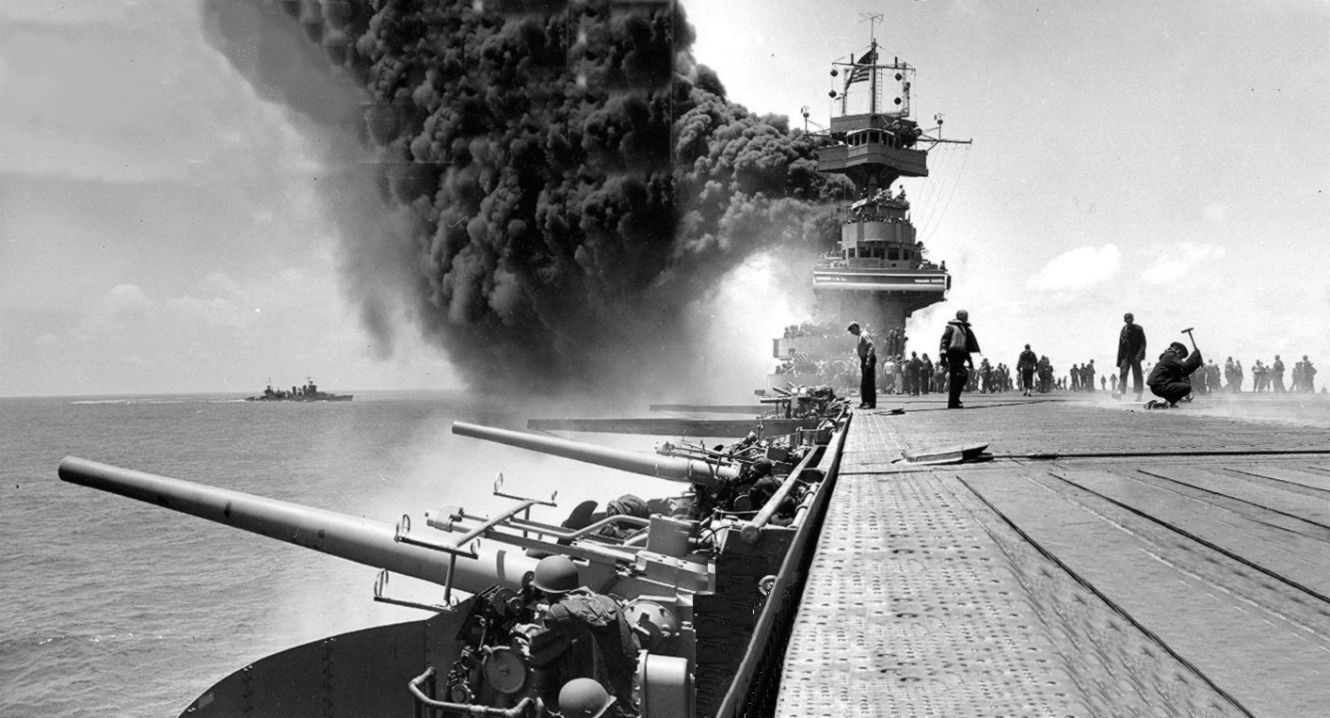
The Battle of Midway was one of the most important naval battles of World War II. Fought between June 4 and June 7, 1942, the battle marked a decisive turning point in the Pacific Theater. Just six months after the attack on Pearl Harbor, the United States Navy dealt a devastating blow to Japan’s naval power, sinking four aircraft carriers and shifting the momentum of the war in favor of the Allies.
Although the battle lasted only four days, its consequences shaped the remainder of the Pacific War. Prior to Midway, Japan appeared unstoppable, having expanded rapidly across Asia and the Pacific. After Midway, Japan increasingly fought on the defensive while the United States gained the strategic initiative.
Quick Facts About the Battle of Midway
| Detail | Information |
|---|---|
| Battle | Battle of Midway |
| Dates | June 4–7, 1942 |
| Location | Near Midway Atoll, Pacific Ocean |
| Belligerents | United States vs Japan |
| Outcome | American Victory |
| Japanese Carriers Lost | 4 |
| Significance | Turning Point of the Pacific War |
What Was Midway Atoll?
Midway Atoll is a small group of islands located roughly halfway between North America and Asia. Despite its remote location, it held enormous strategic value because it could serve as a base for naval and air operations across the Pacific.
Japanese leaders believed capturing Midway would strengthen their defensive perimeter and force the United States into a negotiated peace.
Why Japan Planned the Attack
Following the attack on Pearl Harbor in December 1941, Japan achieved a series of rapid victories throughout the Pacific.
By mid-1942, Japanese commanders sought to eliminate the remaining threat posed by American aircraft carriers.
Japanese Objectives
- Capture Midway Atoll
- Destroy American aircraft carriers
- Expand Japan’s defensive perimeter
- Secure control of the central Pacific
Japanese Admiral Isoroku Yamamoto designed a complex operation intended to lure the U.S. fleet into a trap.
How American Intelligence Changed the Battle
One of the most important reasons for the American victory was intelligence.
U.S. codebreakers had successfully deciphered significant portions of Japan’s naval communications.
American intelligence officers determined that a location identified as “AF” in Japanese messages referred to Midway.
The Famous Water Shortage Trick
To confirm their theory, American forces at Midway sent an unencrypted message reporting a water shortage.
Shortly afterward, Japanese communications reported that “AF” was experiencing water problems.
This confirmed Midway as the target.
The Forces Involved
Japanese Fleet
- Akagi
- Kaga
- Soryu
- Hiryu
- Numerous support vessels
American Fleet
- USS Enterprise
- USS Hornet
- USS Yorktown
Although Japan possessed a larger fleet overall, the Americans benefited from intelligence and strategic preparation.
The Battle Begins
On June 4, 1942, Japanese aircraft launched attacks against Midway.
American aircraft from Midway and nearby carriers responded.
The battle quickly evolved into a contest between carrier-based aircraft operating hundreds of miles apart.
Early American Losses
Several American torpedo squadrons attacked Japanese carriers with little success and suffered heavy casualties.
However, these attacks distracted Japanese fighter aircraft and left the carriers vulnerable.
The Decisive Moment
Late in the morning of June 4, American dive bombers located the Japanese carrier force.
Within minutes, they struck three carriers:
- Akagi
- Kaga
- Soryu
All three suffered catastrophic damage and were eventually lost.
The Loss of Hiryu
The surviving carrier, Hiryu, launched counterattacks that damaged USS Yorktown.
Later that day, American aircraft found and destroyed Hiryu as well.
Japan had lost all four carriers involved in the operation.
Casualties and Losses
| Category | Japan | United States |
|---|---|---|
| Aircraft Carriers Lost | 4 | 1 |
| Aircraft Lost | 300+ | 150+ |
| Personnel Lost | 3,000+ | 300+ |
Why the Battle of Midway Was Important
Japan Lost Experienced Pilots
Japan not only lost carriers but also many highly trained pilots and crew members.
These losses proved difficult to replace.
The Strategic Initiative Shifted
Before Midway, Japan controlled the momentum of the war.
After Midway, the United States increasingly dictated the pace of operations.
The Beginning of Japan’s Decline
Although the war continued for more than three years, Midway marked the beginning of Japan’s gradual retreat across the Pacific.
Impact on the Pacific War
The victory allowed the United States to launch future offensives, including:
- Guadalcanal Campaign
- Island-Hopping Strategy
- Philippines Campaign
- Iwo Jima
- Okinawa
These operations steadily pushed Allied forces closer to Japan.
Interesting Facts About the Battle of Midway
- The battle lasted only four days.
- It occurred six months after Pearl Harbor.
- American codebreakers played a crucial role.
- Four Japanese carriers were sunk.
- Many historians consider Midway the turning point of the Pacific War.
Frequently Asked Questions
Who won the Battle of Midway?
The United States achieved a decisive victory over Japan.
Why was the Battle of Midway important?
It shifted the balance of power in the Pacific and marked the beginning of Japan’s decline.
How many Japanese carriers were lost?
Japan lost four aircraft carriers: Akagi, Kaga, Soryu, and Hiryu.
When did the Battle of Midway take place?
The battle was fought from June 4 to June 7, 1942.
Was Midway the turning point of the Pacific War?
Most historians consider Midway the decisive turning point in the Pacific Theater.
Key Takeaways
- The Battle of Midway was fought from June 4–7, 1942.
- American codebreaking played a critical role in the victory.
- Japan lost four aircraft carriers.
- The battle shifted momentum in the Pacific.
- The United States gained the strategic initiative.
- Midway is widely regarded as the turning point of the Pacific War.
Conclusion
The Battle of Midway was one of the most consequential naval engagements in history. In just four days, the United States reversed the momentum of the Pacific War and inflicted losses that Japan could never fully replace. The battle demonstrated the importance of intelligence, naval aviation, and strategic planning, and it remains one of the defining moments of World War II.
Related Articles
- World War 2 History: Complete Timeline, Causes, Major Battles, and Global Impact
- Japan in World War 2
- Major Battles of World War 2
- World War 2 Timeline
- Pearl Harbor Attack Explained
- Battle of Iwo Jima
- Battle of Okinawa
Leave a Reply