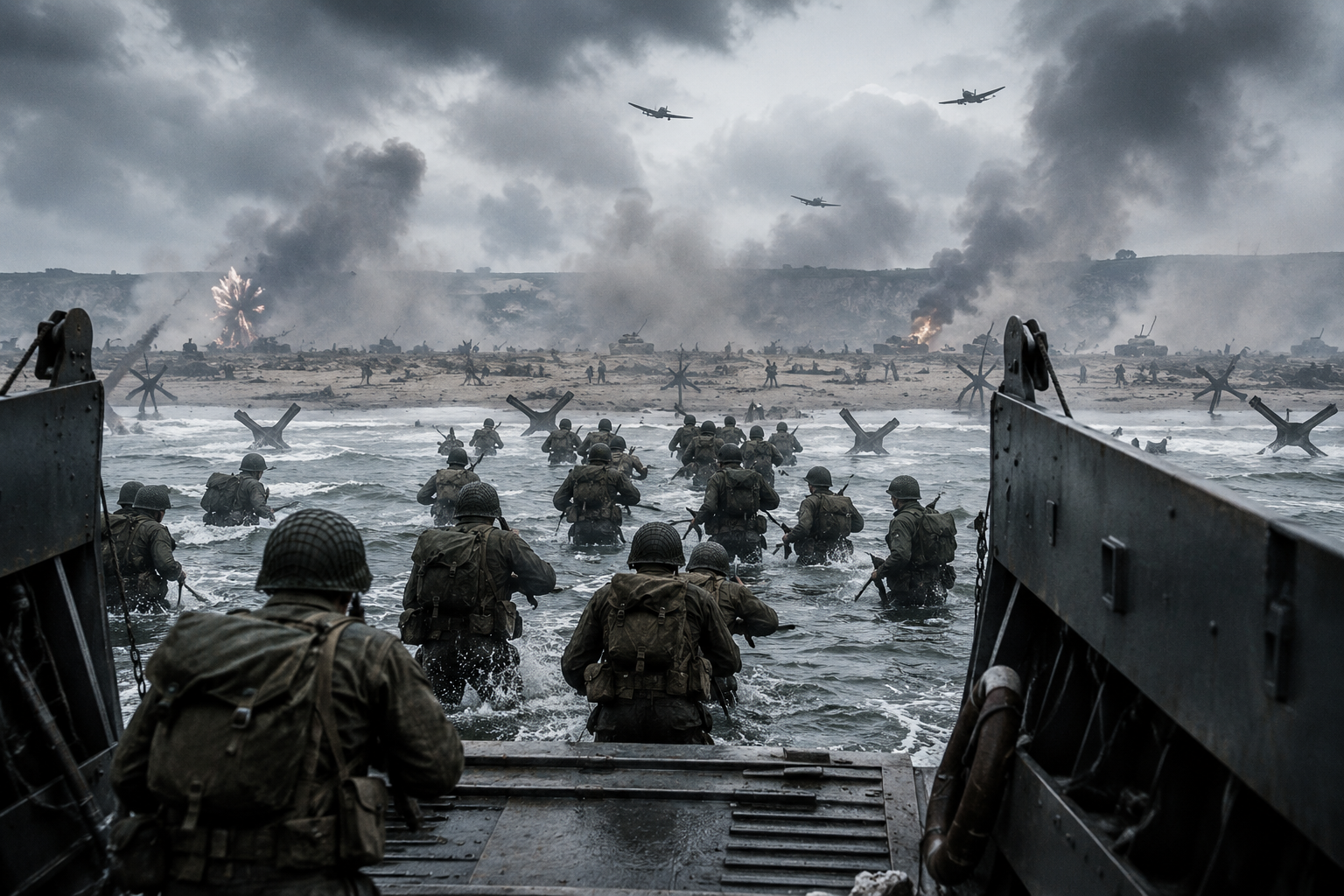
On June 6, 1944, Allied forces launched one of the most ambitious military operations in history. Known as D-Day, the Normandy landings marked the beginning of Operation Overlord, the Allied invasion of German-occupied Western Europe. More than 150,000 Allied troops crossed the English Channel and landed on the beaches of Normandy, France.
The operation opened a Western Front against Nazi Germany and became a turning point in World War II. D-Day ultimately paved the way for the liberation of France and the eventual defeat of Nazi Germany.
Quick Facts About D-Day
| Detail | Information |
|---|---|
| Date | June 6, 1944 |
| Operation | Operation Overlord |
| Location | Normandy, France |
| Allied Troops | 156,000+ |
| Outcome | Allied Victory |
| Significance | Beginning of Western Europe’s liberation |
What Was D-Day?
D-Day refers to the first day of the Allied invasion of Normandy during World War II. The operation involved troops from the United States, United Kingdom, Canada, and other Allied nations.
The goal was to establish a foothold in France and begin pushing German forces out of Western Europe.
Why Was Normandy Chosen?
Allied commanders considered several possible invasion locations.
Normandy was selected because:
- German defenses were weaker than at Calais.
- The beaches could support large-scale landings.
- It allowed access to inland France.
- It provided strategic routes toward Germany.
Operation Fortitude
To keep Germany guessing, the Allies launched a deception campaign called Operation Fortitude.
Fake armies, dummy tanks, and misleading radio traffic convinced German commanders that the invasion would occur elsewhere.
The Five Landing Beaches
The Normandy coastline was divided into five sectors.
| Beach | Country |
|---|---|
| Utah | United States |
| Omaha | United States |
| Gold | United Kingdom |
| Juno | Canada |
| Sword | United Kingdom |
The Airborne Assault
Hours before the beach landings began, thousands of Allied paratroopers were dropped behind enemy lines.
Their objectives included:
- Capturing bridges
- Securing roads
- Disrupting German communications
- Protecting the landing zones
Despite scattered drops and confusion, many airborne units successfully completed their missions.
The Landings Begin
Early on June 6, Allied naval forces bombarded German coastal defenses while landing craft approached the beaches.
Soldiers faced machine-gun fire, artillery, mines, and obstacles placed along the shoreline.
Utah Beach
American forces landed slightly off target but encountered lighter resistance than expected and quickly moved inland.
Omaha Beach
Omaha became the bloodiest landing site. Strong German defenses inflicted heavy casualties on American troops.
Despite severe losses, Allied forces eventually secured the beachhead.
Gold Beach
British troops captured important positions and advanced inland.
Juno Beach
Canadian forces faced intense resistance but achieved many of their objectives by the end of the day.
Sword Beach
British troops landed successfully and pushed toward the city of Caen.
German Response
German commanders initially struggled to determine whether Normandy represented the main Allied invasion.
Because of the Allied deception campaign, some German forces remained stationed elsewhere.
This delay gave the Allies valuable time to strengthen their position.
Casualties on D-Day
| Side | Estimated Casualties |
|---|---|
| Allied Forces | Approximately 10,000 |
| German Forces | Approximately 4,000–9,000 |
Thousands of soldiers lost their lives during the first day of the invasion.
Why D-Day Was Important
Opened a Western Front
The invasion forced Germany to fight major Allied forces in Western Europe while continuing to battle the Soviet Union in the East.
Led to the Liberation of France
Within months, Allied forces liberated Paris and much of France.
Accelerated Germany’s Defeat
D-Day marked the beginning of the end for Nazi Germany.
Operation Overlord After D-Day
The Normandy landings were only the beginning.
Allied forces continued fighting through:
- Battle of Normandy
- Liberation of Paris
- Operation Market Garden
- Battle of the Bulge
- Invasion of Germany
Interesting Facts About D-Day
- D-Day involved more than 5,000 ships and landing craft.
- Over 11,000 Allied aircraft supported the invasion.
- It remains the largest amphibious invasion in history.
- More than 156,000 Allied troops landed in Normandy.
- Operation Fortitude helped deceive German commanders.
Frequently Asked Questions
What does D-Day stand for?
Military planners used “D-Day” to indicate the day an operation begins. For June 6, 1944, it became the common name for the Normandy invasion.
Why was D-Day important?
It opened a Western Front in Europe and accelerated the defeat of Nazi Germany.
Which beach had the heaviest casualties?
Omaha Beach experienced the highest Allied casualties during the landings.
How many troops landed on D-Day?
More than 156,000 Allied troops landed in Normandy on June 6, 1944.
Who participated in D-Day?
The operation involved forces from the United States, United Kingdom, Canada, and several Allied nations.
Key Takeaways
- D-Day occurred on June 6, 1944.
- It was part of Operation Overlord.
- The invasion targeted five Normandy beaches.
- More than 156,000 Allied troops participated.
- Operation Fortitude helped deceive Germany.
- D-Day opened a Western Front in Europe.
- The invasion contributed directly to Germany’s eventual defeat.
Conclusion
D-Day was one of the most important military operations in modern history. Through careful planning, deception, and extraordinary bravery, Allied forces established a foothold in Western Europe and began the liberation of territories occupied by Nazi Germany. The success of the Normandy landings helped change the course of World War II and remains a symbol of courage, sacrifice, and international cooperation.
Related Articles
- World War 2 History: Complete Timeline, Causes, Major Battles, and Global Impact
- Major Battles of World War 2
- Germany in World War 2
- World War 2 Timeline
- Battle of Stalingrad
- Axis Powers vs Allied Powers
- Battle of the Bulge
Leave a Reply