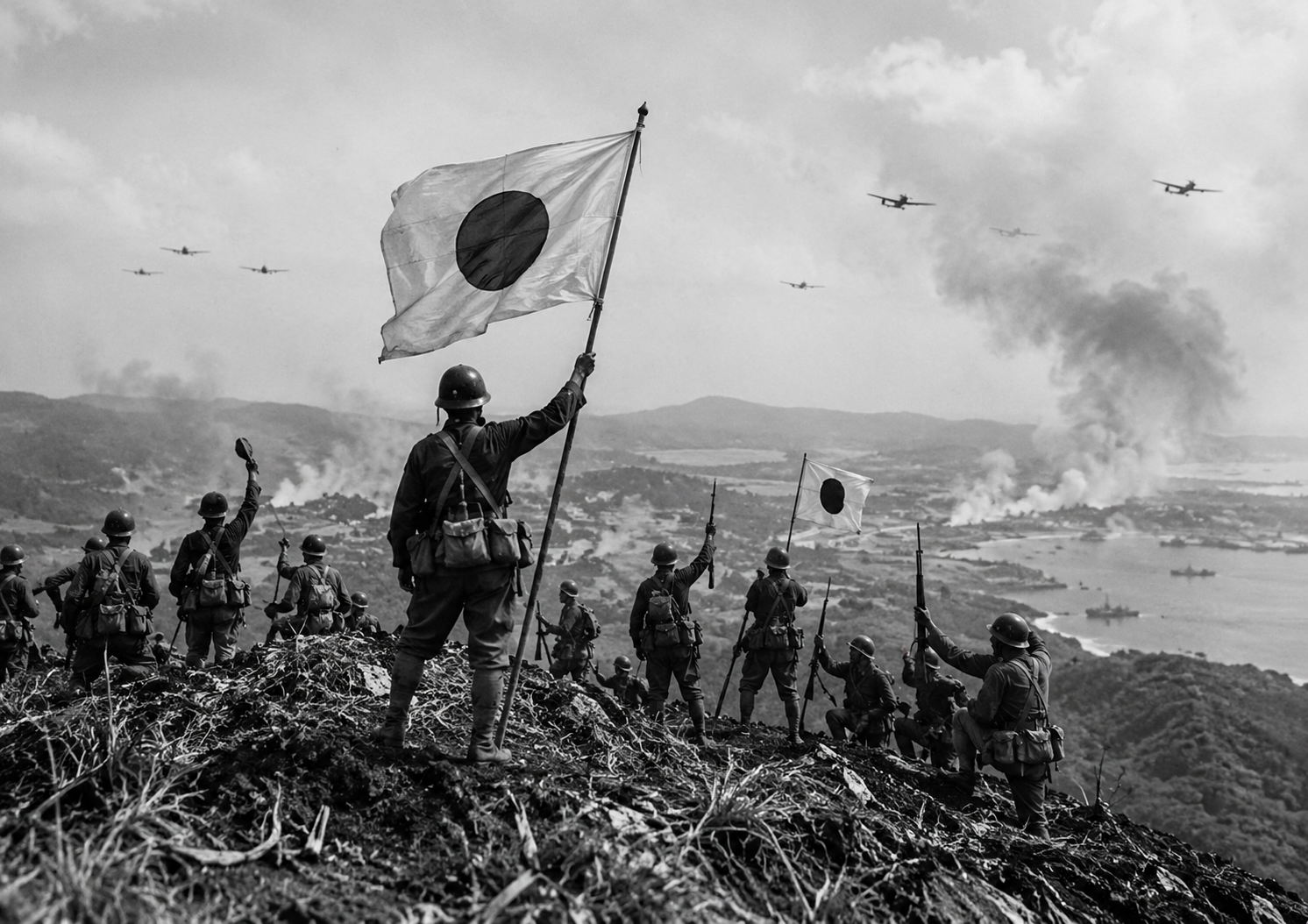
This is one of the most important supporting articles because it covers:
- Japan’s role in WWII
- Pearl Harbor
- Pacific War
- Battle of Midway
- Hiroshima and Nagasaki
- Japan’s surrender
It also creates future article opportunities around Pearl Harbor, Midway, Iwo Jima, Okinawa, and the Pacific Theater.
Japan in World War 2: Expansion, Pearl Harbor, and Defeat
Japan played a central role in World War II as one of the three major Axis Powers alongside Germany and Italy. While Germany dominated the conflict in Europe, Japan pursued military expansion across East Asia and the Pacific, creating a vast empire that stretched from China to Southeast Asia.
Japan’s ambitions eventually brought it into direct conflict with the United States, the British Empire, China, and numerous Allied nations. The attack on Pearl Harbor in December 1941 transformed the war into a truly global conflict and marked the beginning of some of the most intense naval and island battles in history.
By the time Japan surrendered in September 1945, millions had died, entire cities had been destroyed, and the world had entered the nuclear age.
Why Did Japan Expand Before World War II?
Unlike many Western powers, Japan had limited natural resources.
The country relied heavily on imports for:
- Oil
- Rubber
- Iron ore
- Coal
- Industrial materials
Japanese leaders believed territorial expansion was necessary to secure resources and strengthen national security.
Goals of Japanese Expansion
Japan sought to:
- Control resource-rich territories
- Expand political influence
- Reduce dependence on foreign imports
- Establish dominance in East Asia
These ambitions would eventually lead to conflict with neighboring countries and Western powers.
Japan Invades Manchuria (1931)
Japan’s expansion began before World War II officially started.
In 1931, Japanese forces invaded Manchuria, a region in northeastern China.
The invasion led to the creation of the puppet state known as Manchukuo.
Although international organizations criticized the action, no major military response followed.
Why It Was Important
The lack of consequences encouraged further Japanese expansion and demonstrated the weakness of international diplomacy.
The Second Sino-Japanese War (1937)
In July 1937, full-scale war erupted between Japan and China.
Japanese forces captured several major cities, including:
- Beijing
- Shanghai
- Nanjing
The Nanjing Massacre
Following the capture of Nanjing, Japanese troops committed widespread atrocities against civilians and prisoners of war.
Historians estimate that hundreds of thousands of people were killed.
The event remains one of the most controversial and tragic episodes of the war.
Japan Joins the Axis Powers
Japan formally strengthened its relationship with Germany and Italy by signing the Tripartite Pact in September 1940.
The agreement established the three nations as the core Axis Powers.
Axis Cooperation
Although separated geographically, Germany, Italy, and Japan shared several objectives:
- Territorial expansion
- Military strength
- Opposition to Western influence
The alliance created a powerful military coalition spanning Europe and Asia.
Why Did Japan Attack Pearl Harbor?
By 1941, tensions between Japan and the United States had increased significantly.
The United States imposed economic sanctions and oil embargoes in response to Japanese expansion in Asia.
Japanese leaders feared these restrictions would cripple their military and economy.
The Decision to Attack
Japan hoped a surprise attack would:
- Destroy American naval power in the Pacific
- Prevent U.S. intervention
- Allow rapid territorial expansion
The plan centered on the U.S. Pacific Fleet stationed at Pearl Harbor, Hawaii.
The Attack on Pearl Harbor
On December 7, 1941, Japanese aircraft launched a surprise attack on Pearl Harbor.
The attack damaged or destroyed:
- Battleships
- Aircraft
- Military facilities
More than 2,400 Americans were killed.
Immediate Consequences
The following day, the United States declared war on Japan.
Germany and Italy soon declared war on the United States.
World War II had become a global conflict.
Japan’s Rapid Expansion Across Asia
Following Pearl Harbor, Japan achieved a series of military victories.
Japanese forces captured:
- Hong Kong
- Singapore
- Philippines
- Malaya
- Burma
- Dutch East Indies
At its peak, Japan controlled one of the largest empires in Asia.
Why These Territories Mattered
Many contained valuable resources such as:
- Oil
- Rubber
- Minerals
- Strategic ports
These resources were essential for sustaining Japan’s war effort.
Battle of Midway: The Turning Point
In June 1942, Japan attempted to seize Midway Atoll.
American intelligence successfully decoded Japanese plans.
The Battle
U.S. forces launched a surprise attack against the Japanese fleet.
Japan lost:
- Four aircraft carriers
- Hundreds of aircraft
- Many experienced pilots
Why Midway Was Important
Many historians consider Midway the turning point of the Pacific War.
After Midway, Japan increasingly fought on the defensive.
Island-Hopping Campaign
The United States adopted a strategy known as island hopping.
Rather than attacking every Japanese position, Allied forces targeted strategically important islands.
Major campaigns included:
- Guadalcanal
- Tarawa
- Saipan
- Iwo Jima
- Okinawa
Each victory brought Allied forces closer to Japan.
Battle of Iwo Jima
Fought between February and March 1945, Iwo Jima became one of the Pacific War’s most famous battles.
Why It Was Important
The island provided:
- Emergency landing sites
- Strategic airfields
- Improved bombing operations against Japan
The iconic image of American troops raising the flag on Mount Suribachi became a symbol of Allied determination.
Battle of Okinawa
The Battle of Okinawa began in April 1945.
It became the largest amphibious assault in the Pacific Theater.
Casualties
The battle resulted in:
- Heavy military losses
- Massive civilian casualties
- Extensive destruction
The ferocity of the fighting influenced Allied planning for a possible invasion of mainland Japan.
Hiroshima and Nagasaki
By 1945, Japan faced defeat but continued fighting.
The United States developed atomic weapons through the Manhattan Project.
Hiroshima
On August 6, 1945, an atomic bomb was dropped on Hiroshima.
The explosion devastated the city.
Nagasaki
A second atomic bomb was dropped on Nagasaki on August 9, 1945.
The destruction further weakened Japan’s ability to continue the war.
Japan’s Surrender
On August 15, 1945, Emperor Hirohito announced Japan’s surrender.
The formal surrender ceremony occurred on September 2, 1945, aboard the USS Missouri.
Why Japan Surrendered
Several factors contributed:
- Atomic bombings
- Soviet declaration of war
- Economic collapse
- Military defeat
The surrender officially ended World War II.
Impact of World War II on Japan
The war transformed Japan politically, economically, and socially.
Major Changes
- Military government abolished
- Democratic reforms introduced
- New constitution adopted
- Economic reconstruction began
Japan eventually became one of the world’s leading economic powers.
Key Dates in Japan’s World War II History
| Date | Event |
|---|---|
| 1931 | Invasion of Manchuria |
| 1937 | War with China begins |
| 1940 | Tripartite Pact signed |
| Dec 7, 1941 | Pearl Harbor attack |
| June 1942 | Battle of Midway |
| Feb 1945 | Battle of Iwo Jima |
| Apr 1945 | Battle of Okinawa |
| Aug 6, 1945 | Hiroshima bombing |
| Aug 9, 1945 | Nagasaki bombing |
| Sept 2, 1945 | Japan surrenders |
Frequently Asked Questions
Why did Japan enter World War II?
Japan sought territorial expansion and access to natural resources across Asia and the Pacific.
Why did Japan attack Pearl Harbor?
Japan hoped to weaken American naval power and secure freedom of action in Asia.
What was Japan’s biggest defeat?
Many historians consider the Battle of Midway Japan’s most significant defeat.
When did Japan surrender?
Japan formally surrendered on September 2, 1945.
What ended the war with Japan?
The atomic bombings, Soviet entry into the war, and military defeats contributed to Japan’s surrender.
Key Takeaways
- Japan was one of the three principal Axis Powers.
- Expansion began with the invasion of Manchuria in 1931.
- Japan attacked Pearl Harbor in 1941.
- The Battle of Midway shifted momentum to the Allies.
- Island-hopping campaigns brought Allied forces closer to Japan.
- Hiroshima and Nagasaki introduced nuclear warfare.
- Japan surrendered on September 2, 1945.
- The war transformed Japan’s political and economic future.
Leave a Reply