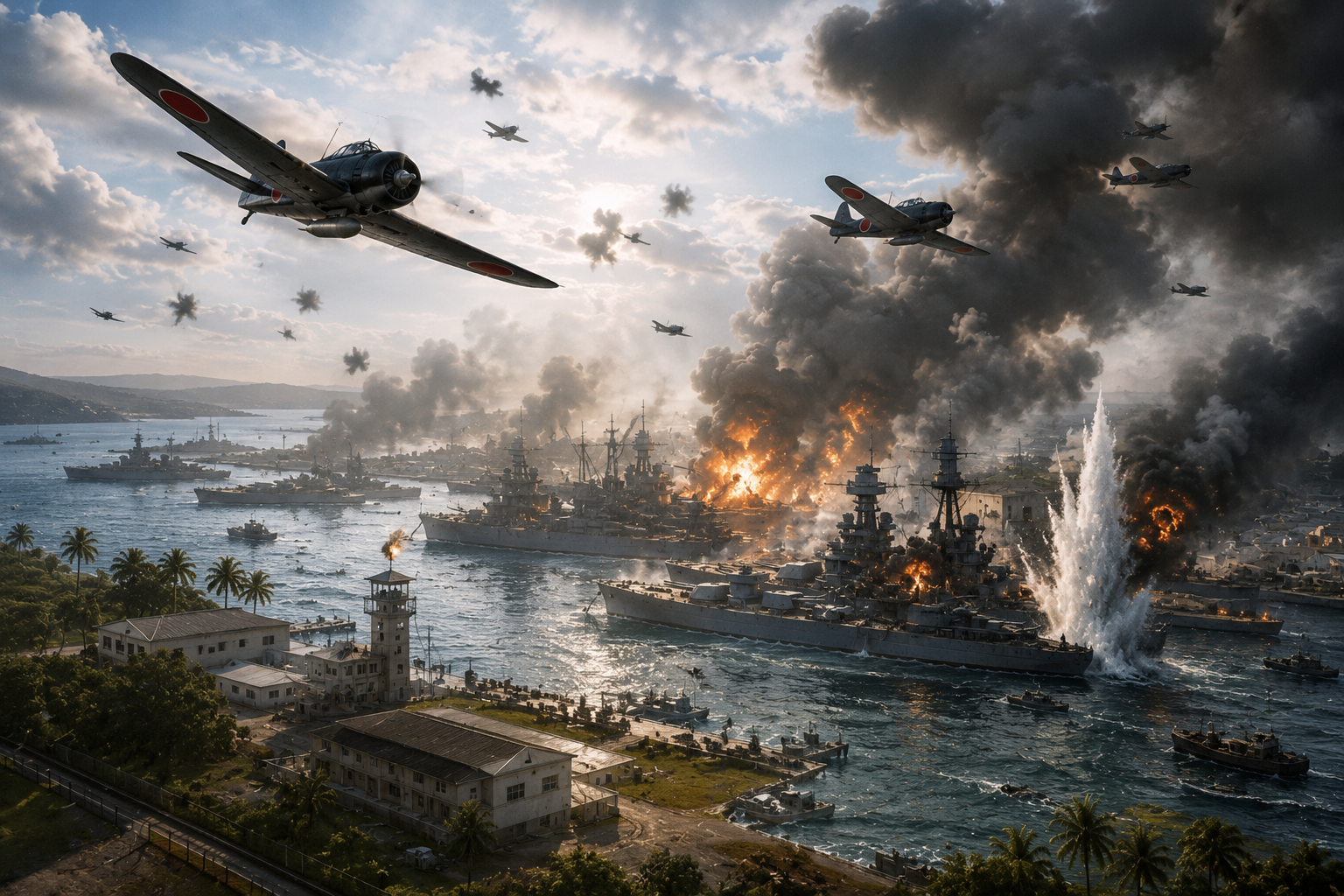
On the morning of December 7, 1941, the United States experienced one of the most shocking attacks in its history. Japanese aircraft launched a surprise assault on Pearl Harbor, a major American naval base located in Hawaii. The attack killed thousands of military personnel and civilians, damaged much of the U.S. Pacific Fleet, and dramatically altered the course of World War II.
Before Pearl Harbor, the United States had largely remained outside the fighting despite providing support to Allied nations. Within twenty-four hours of the attack, America declared war on Japan and entered World War II, transforming the conflict into a truly global war.
Quick Facts About the Pearl Harbor Attack
| Detail | Information |
|---|---|
| Date | December 7, 1941 |
| Location | Pearl Harbor, Hawaii |
| Attacker | Empire of Japan |
| Defender | United States |
| Duration | Approximately 90 minutes |
| Outcome | Japanese Tactical Victory |
| Long-Term Result | United States entered World War II |
What Was Pearl Harbor Attack?
Pearl Harbor was the primary base of the United States Pacific Fleet. Located on the island of Oahu in Hawaii, the harbor served as a strategic naval center responsible for protecting American interests in the Pacific Ocean.
By 1941, numerous battleships, cruisers, destroyers, submarines, and aircraft were stationed there.
Why Did Japan Attack Pearl Harbor?
Relations between Japan and the United States had become increasingly tense during the late 1930s and early 1940s.
Japan was expanding throughout Asia while the United States opposed these actions through economic sanctions and trade restrictions.
Economic Pressure on Japan
The United States restricted exports of critical materials such as:
- Oil
- Steel
- Industrial resources
Japanese leaders feared these restrictions would weaken their military and economy.
Japan’s Strategic Goal
Japan hoped a surprise attack would cripple American naval power long enough to secure its newly conquered territories across Asia and the Pacific.
Planning the Pearl Harbor Attack
The operation was planned by Admiral Isoroku Yamamoto, commander of Japan’s Combined Fleet.
The Japanese strategy depended on surprise.
Six aircraft carriers secretly crossed the Pacific Ocean and positioned themselves north of Hawaii before launching the attack.
The Morning of December 7, 1941
At approximately 7:55 a.m., Japanese aircraft began attacking Pearl Harbor.
The assault occurred in two waves.
First Wave
The first wave targeted:
- Battleships
- Airfields
- Military installations
Many American aircraft were destroyed before they could take off.
Second Wave
The second wave focused on:
- Additional ships
- Air defense systems
- Military facilities
Within ninety minutes, extensive damage had been inflicted.
The USS Arizona Disaster
One of the most devastating moments occurred when a bomb struck the USS Arizona.
The explosion ignited ammunition stored aboard the battleship.
The ship sank rapidly, killing more than 1,100 sailors and Marines.
Today, the USS Arizona Memorial stands above the wreckage as a tribute to those who lost their lives.
Damage Caused by the Pearl Harbor Attack
| Category | Losses |
|---|---|
| American Deaths | 2,403 |
| American Wounded | 1,178 |
| Battleships Damaged or Sunk | 8 |
| Aircraft Destroyed | 188 |
| Aircraft Damaged | 159 |
What Japan Failed to Destroy
Although the attack appeared successful, several critical American assets survived.
Aircraft Carriers Were Absent
The U.S. aircraft carriers assigned to Pearl Harbor were not in port during the attack.
These carriers would later become crucial in battles such as Midway.
Fuel Storage Facilities Survived
Large fuel depots remained intact.
This allowed the United States Navy to continue operating effectively from Hawaii.
Repair Facilities Remained Functional
Important dry docks and repair facilities were largely undamaged.
Many damaged ships were eventually repaired and returned to service.
America Responds
On December 8, 1941, President Franklin D. Roosevelt addressed Congress.
He described December 7 as:
“A date which will live in infamy.”
Congress overwhelmingly voted to declare war on Japan.
Germany and Italy Declare War
On December 11, 1941, Germany and Italy declared war on the United States.
The United States responded by declaring war on both nations.
America was now fully involved in World War II.
Impact on World War II
Unified American Public Opinion
Before Pearl Harbor, many Americans preferred to remain out of the war.
The attack changed public opinion almost overnight.
Industrial Mobilization
The United States rapidly expanded military production.
Factories began producing:
- Aircraft
- Tanks
- Ships
- Weapons
The Beginning of the Pacific Counteroffensive
American forces eventually pushed Japan back through a series of major campaigns, including Midway, Guadalcanal, Iwo Jima, and Okinawa.
Pearl Harbor Today
Pearl Harbor remains an active military installation and one of the most visited historical sites in the United States.
Visitors can explore:
- USS Arizona Memorial
- Battleship Missouri Memorial
- Pearl Harbor Aviation Museum
- Pacific Fleet Submarine Museum
Interesting Facts About Pearl Harbor Attack
- The attack lasted less than two hours.
- More than 350 Japanese aircraft participated.
- The USS Arizona remains submerged today.
- American aircraft carriers escaped damage because they were away from the harbor.
- The attack directly led to U.S. involvement in World War II.
Frequently Asked Questions
Why did Japan attack Pearl Harbor?
Japan hoped to weaken American naval power and secure its expansion across Asia and the Pacific.
How many people died at Pearl Harbor Attack?
Approximately 2,403 Americans were killed during the attack.
How long did the attack last?
The attack lasted approximately 90 minutes.
Did Pearl Harbor destroy the U.S. Navy?
No. Although significant damage occurred, many important assets survived, including aircraft carriers and repair facilities.
Why is Pearl Harbor important?
The attack brought the United States into World War II and changed the course of global history.
Key Takeaways
- Pearl Harbor was attacked on December 7, 1941.
- Japan launched a surprise assault against the U.S. Pacific Fleet.
- More than 2,400 Americans were killed.
- The USS Arizona suffered catastrophic losses.
- The attack brought the United States into World War II.
- American industrial and military mobilization followed immediately.
- Pearl Harbor remains one of the most significant events in modern history.
Conclusion
The attack on Pearl Harbor transformed World War II and reshaped the twentieth century. What Japan intended as a decisive blow instead united the United States and accelerated its rise as a global military power. The events of December 7, 1941, continue to be remembered as a defining moment in American and world history.
Related Articles
- Japan in World War 2
- Battle of Midway
- World War 2 Timeline
- Major Battles of World War 2
- Axis Powers vs Allied Powers
- D-Day: The Normandy Landings That Changed World War II
7 December 1941
Japan launched a surprise air attack on the U.S. naval base at Pearl Harbor in Hawaii early on a Sunday morning.
Devastating Strike
Battleships, aircraft, and military facilities suffered heavy damage, while more than 2,400 Americans lost their lives during the attack.
Day of Infamy
On 8 December 1941, President Franklin D. Roosevelt delivered his famous “Day of Infamy” speech before Congress.
War Declared
Congress declared war on Japan, bringing the United States fully into World War II the day after the attack.
Historic Impact
Pearl Harbor transformed the global conflict, leading to America’s full military involvement in both the Pacific and European theaters.
Leave a Reply