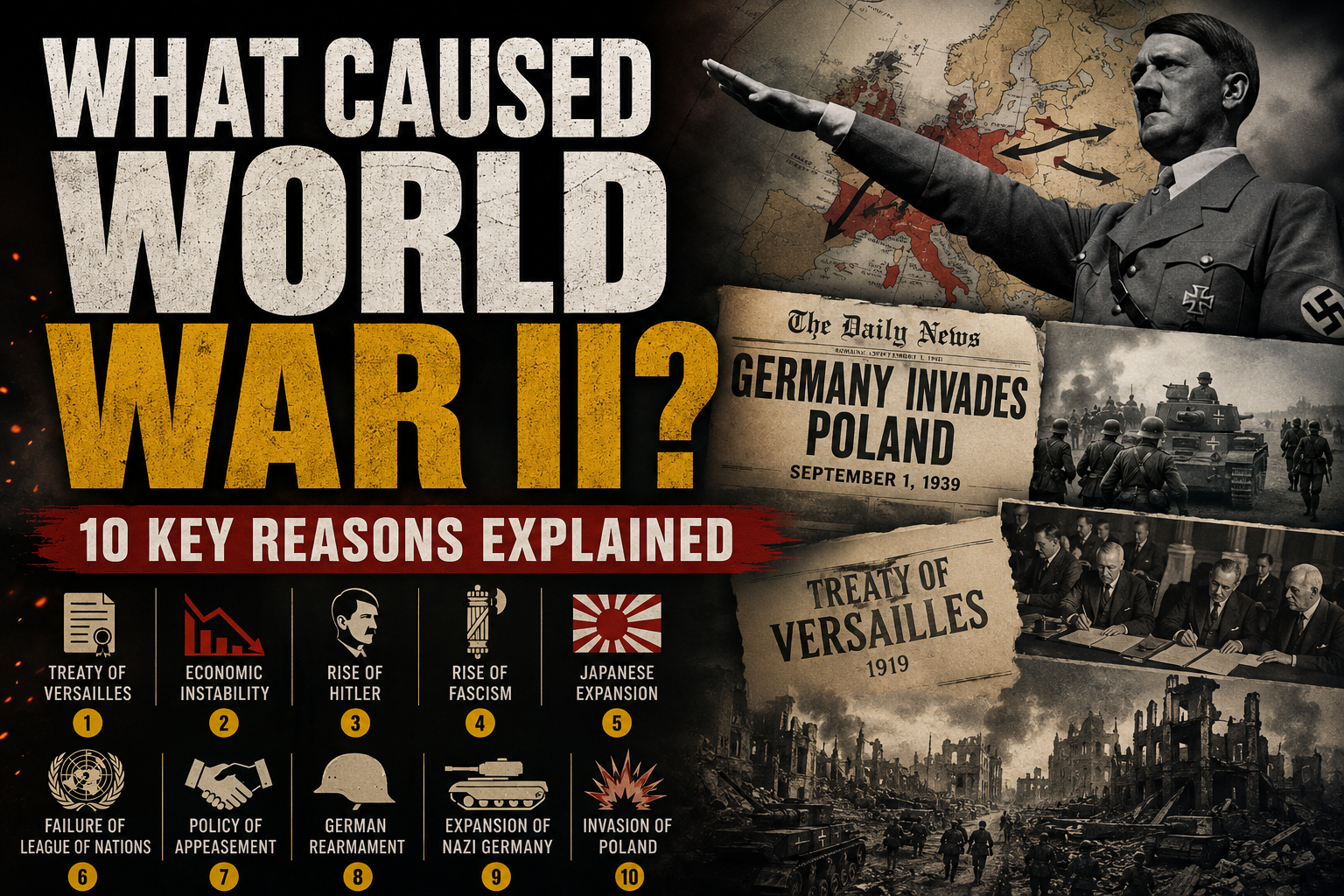
World War II was not triggered by a single event. Instead, it was the result of years of political tension, economic hardship, military expansion, and failed diplomacy. While Germany’s invasion of Poland on September 1, 1939, officially marked the beginning of the war, the foundations of the conflict had been building since the end of World War I.
The war eventually involved more than 30 countries and became the deadliest conflict in human history. Understanding its causes helps explain how Europe and much of the world descended into global warfare only two decades after the First World War.
This article examines the ten most important causes of World War II and how they combined to create one of history’s most devastating conflicts.
1. The Treaty of Versailles
The Treaty of Versailles, signed in 1919, officially ended World War I.
Germany was forced to:
- Accept responsibility for the war
- Pay heavy reparations
- Reduce its military
- Surrender territory
Many Germans viewed the treaty as unfair and humiliating.
The resulting resentment created fertile ground for political movements that promised to restore Germany’s power and prestige.
Why It Mattered
The treaty weakened Germany economically and politically while fueling nationalist anger that extremist leaders would later exploit.
2. Economic Instability and the Great Depression
The global economy suffered significantly during the 1920s and 1930s.
The Great Depression caused:
- Massive unemployment
- Business failures
- Political instability
- Social unrest
Millions of people lost confidence in democratic governments.
In many countries, citizens became more willing to support strong leaders who promised economic recovery and national renewal.
Why It Mattered
Economic hardship helped extremist political parties gain support across Europe.
3. The Rise of Adolf Hitler
Adolf Hitler became Chancellor of Germany in 1933.
He promoted aggressive nationalism and promised to:
- Restore German military power
- Reverse the Treaty of Versailles
- Expand German territory
- Unite German-speaking populations
Under Hitler’s leadership, Germany rapidly rearmed and adopted increasingly aggressive foreign policies.
Why It Mattered
Hitler’s ambitions became one of the primary driving forces behind the outbreak of war.
4. The Rise of Fascism in Europe
Germany was not the only nation embracing authoritarian rule.
Italy, under Benito Mussolini, promoted Fascism and sought to expand its influence.
Authoritarian governments often emphasized:
- Military strength
- Nationalism
- Territorial expansion
These ideologies increased tensions between nations and undermined international cooperation.
Why It Mattered
Fascist governments were more willing to pursue military solutions to political problems.
5. Japanese Expansion in Asia
Japan sought to build an empire across East Asia and the Pacific.
The country invaded Manchuria in 1931 and launched a full-scale invasion of China in 1937.
Japan wanted access to:
- Natural resources
- Strategic territories
- Economic opportunities
Why It Mattered
Japanese expansion contributed to instability in Asia and eventually brought the United States into the war.
6. Failure of the League of Nations
The League of Nations was created after World War I to prevent future conflicts.
However, it lacked the power to enforce its decisions.
When countries such as Germany, Italy, and Japan violated international agreements, the League struggled to respond effectively.
Why It Mattered
Aggressive nations learned they could often act without facing serious consequences.
7. Policy of Appeasement
Many European leaders wanted to avoid another major war.
As a result, Britain and France adopted a policy known as appeasement.
They allowed Germany to make several territorial gains without military opposition.
Examples included:
- Remilitarization of the Rhineland
- Annexation of Austria
- Occupation of the Sudetenland
Why It Mattered
Appeasement convinced Hitler that the Western powers were unlikely to stop further expansion.
8. German Rearmament
The Treaty of Versailles placed strict limits on Germany’s military.
Hitler openly ignored these restrictions.
Germany rapidly expanded:
- Army
- Air Force
- Navy
- Weapons production
By the late 1930s, Germany possessed one of the strongest military forces in Europe.
Why It Mattered
Military strength gave Germany the confidence to pursue increasingly aggressive actions.
9. Expansion of Nazi Germany
Before invading Poland, Germany had already expanded significantly.
Major actions included:
| Year | Event |
|---|---|
| 1936 | Rhineland Remilitarized |
| 1938 | Austria Annexed |
| 1938 | Sudetenland Acquired |
| 1939 | Czechoslovakia Occupied |
| 1939 | Poland Invaded |
Each success encouraged further expansion.
Why It Mattered
Territorial gains increased Germany’s power while weakening European stability.
10. The Invasion of Poland
The immediate trigger for World War II was Germany’s invasion of Poland on September 1, 1939.
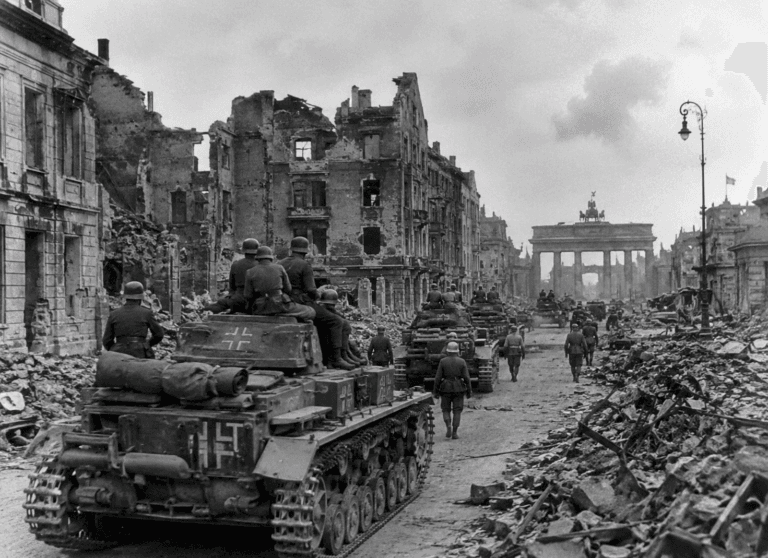
German forces launched a coordinated Blitzkrieg campaign that quickly overwhelmed Polish defenses.
Two days later, Britain and France declared war on Germany.
Why It Mattered
The invasion transformed years of tension into open global conflict.
How These Causes Worked Together
No single factor caused World War II.
Instead, the war resulted from a combination of:
- Political grievances
- Economic hardship
- Nationalism
- Military expansion
- Failed diplomacy
- Weak international institutions
Together, these conditions created an environment where large-scale war became increasingly likely.
Summary Table: Top 10 Causes of World War II
| Cause | Impact |
|---|---|
| Treaty of Versailles | German resentment |
| Great Depression | Political instability |
| Adolf Hitler | Aggressive expansion |
| Fascism | Militarization |
| Japanese Expansion | Asian conflict |
| Weak League of Nations | Lack of enforcement |
| Appeasement | Encouraged aggression |
| Rearmament | Increased military power |
| Nazi Expansion | Regional instability |
| Invasion of Poland | Immediate trigger |
Frequently Asked Questions
What was the main cause of World War II?
Most historians identify the Treaty of Versailles, the rise of Adolf Hitler, and German expansionism as the most significant causes.
What event officially started World War II?
Germany’s invasion of Poland on September 1, 1939.
Why was the Treaty of Versailles important?
It created resentment and economic hardship in Germany following World War I.
Did appeasement cause World War II?
Appeasement did not directly cause the war, but it allowed Germany to expand without significant resistance.
Could World War II have been prevented?
Historians continue to debate this question, but stronger international responses to early acts of aggression may have changed the course of events.
Key Takeaways
- World War II had multiple causes rather than a single trigger.
- The Treaty of Versailles created lasting resentment in Germany.
- Economic hardship contributed to political extremism.
- Adolf Hitler’s ambitions played a central role.
- Fascism and militarism increased tensions worldwide.
- The League of Nations failed to stop aggression.
- Appeasement encouraged further German expansion.
- Japan’s actions destabilized Asia.
- Germany’s invasion of Poland triggered the war.
- Understanding these causes helps explain how global conflict became unavoidable by 1939.
Leave a Reply