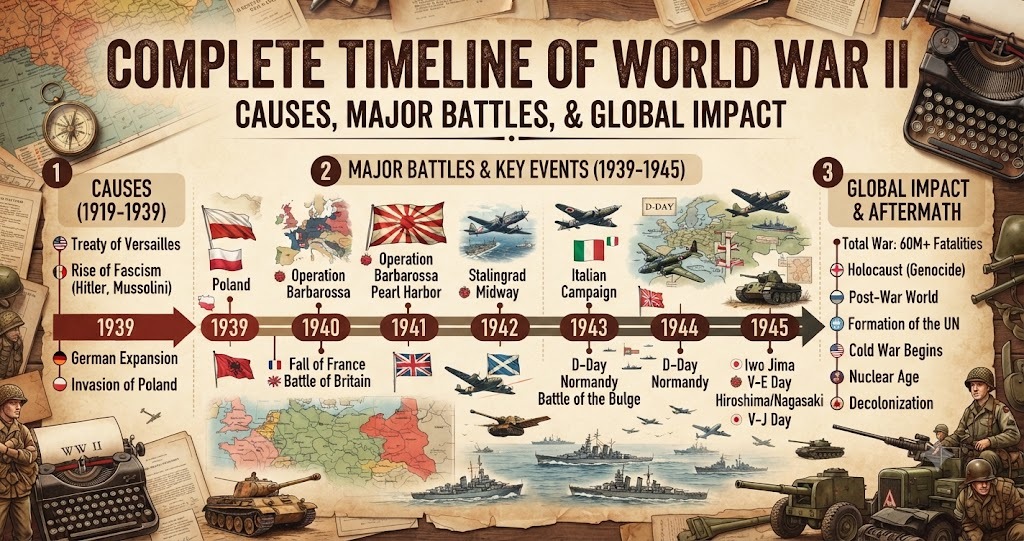
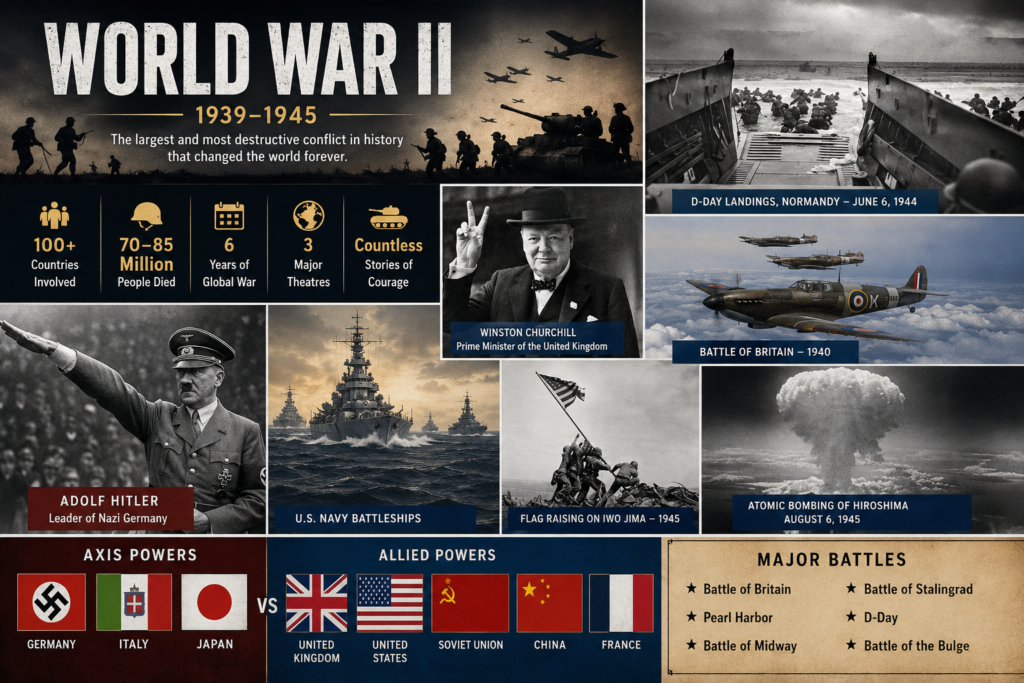
World War 2 History was the largest and most destructive conflict in human history. Fought between 1939 and 1945, the war involved more than 100 million people from over 30 countries and reshaped the political, economic, and social landscape of the modern world. By the time the fighting ended, an estimated 70 to 85 million people had lost their lives, entire cities had been destroyed, and new global powers had emerged.
The war began on September 1, 1939, when Germany invaded Poland. Within days, Britain and France declared war on Germany, transforming a regional conflict into a global struggle. Over the next six years, battles raged across Europe, North Africa, Asia, and the Pacific. Nations mobilized their industries, economies, and populations on an unprecedented scale, while technological innovations changed the nature of warfare forever.
At its core, World War II was the result of unresolved tensions from the First World War, economic instability, political extremism, and aggressive territorial expansion. The conflict brought together two opposing alliances: the Axis Powers, led by Germany, Italy, and Japan, and the Allied Powers, led by the United Kingdom, the Soviet Union, the United States, China, and many others.
This guide provides a complete overview of World War II, including its causes, major events, key leaders, decisive battles, and lasting impact on the world.
What Was World War 2 ?
World War II was a global military conflict fought primarily between the Axis Powers and the Allied Powers between 1939 and 1945. Unlike previous wars, it was fought across multiple continents and oceans simultaneously, involving armies, navies, air forces, resistance movements, and civilian populations.
The conflict affected nearly every part of the world. European cities endured extensive bombing campaigns, while fierce battles unfolded in the Pacific islands, the deserts of North Africa, and the Eastern Front between Germany and the Soviet Union. Civilian populations were increasingly targeted, leading to widespread suffering, displacement, and genocide.
One of the defining aspects of the war was its scale. Entire economies were converted to support military production. Factories produced tanks, aircraft, ships, and weapons around the clock. Scientific advances led to innovations such as radar, improved codebreaking techniques, jet aircraft, and ultimately the development of atomic weapons.
The war also witnessed some of history’s most significant events, including the Holocaust, the Battle of Stalingrad, the D-Day landings, the Battle of Midway, and the atomic bombings of Hiroshima and Nagasaki.
Quick Facts About World War 2 History
| Fact | Details |
|---|
| Duration | 1939–1945 |
| Start Date | September 1, 1939 |
| End Date | September 2, 1945 |
| Main Alliances | Axis Powers and Allied Powers |
| Estimated Death Toll | 70–85 Million |
| Largest Front | Eastern Front |
| Decisive Pacific Battle | Battle of Midway |
| Largest Amphibious Invasion | D-Day (Normandy Landings) |
| Outcome | Allied Victory |
| Major Legacy | Creation of the United Nations |
When Did World War II Start?
World War II officially began on September 1, 1939, when Germany launched a military invasion of Poland. German forces used a strategy known as Blitzkrieg, or “lightning war,” combining fast-moving tanks, aircraft, and infantry to overwhelm Polish defenses.
Britain and France had pledged to protect Poland against aggression. When Germany refused to withdraw, both countries declared war on Germany on September 3, 1939.
Although fighting had erupted in other parts of the world before 1939, particularly during Japan’s expansion into China, the invasion of Poland is widely recognized as the event that triggered the global conflict known as World War II.
Why Poland Was Important?
Poland occupied a strategic position in Europe and was viewed by Adolf Hitler as essential to Germany’s territorial ambitions. The invasion demonstrated that diplomatic efforts to prevent war had failed and signaled the collapse of the fragile peace that had existed since the end of World War I.
Within weeks, Poland was defeated and divided between Germany and the Soviet Union under the terms of the secret Molotov-Ribbentrop Pact.
This marked the beginning of six years of global warfare that would change the course of history.
Causes of World War II
World War II did not begin because of a single event. Instead, it was the result of political, economic, and social tensions that had been building for decades. Historians generally point to several key factors that created the conditions for another major war.
The Treaty of Versailles
When World War I ended in 1918, the victorious Allied nations imposed harsh terms on Germany through the Treaty of Versailles. Signed in 1919, the treaty forced Germany to accept responsibility for the war, surrender territory, reduce its military, and pay substantial reparations.
Many Germans viewed the treaty as humiliating and unfair. Economic hardship, combined with national resentment, created fertile ground for extremist political movements that promised to restore Germany’s power and prestige.
The Rise of Adolf Hitler
Adolf Hitler became Chancellor of Germany in 1933 and quickly transformed the country into a totalitarian state. Under rule, Germany rearmed in violation of international agreements, expanded its military capabilities, and pursued aggressive territorial ambitions.
Hitler’s ideology centered on German expansion, racial supremacy, and the creation of what he called “living space” for the German people. His policies increasingly brought Germany into conflict with neighboring nations.
The Global Economic Crisis
The Great Depression of the 1930s devastated economies around the world. Massive unemployment and social unrest weakened democratic governments and contributed to the rise of authoritarian leaders in several countries.
Economic instability fueled nationalism and encouraged governments to pursue aggressive policies aimed at securing resources, markets, and territory.
Expansionist Policies
Germany was not alone in seeking territorial expansion.
- Germany annexed Austria in 1938.
- Germany occupied Czechoslovakia in 1939.
- Italy invaded Ethiopia in 1935.
- Japan expanded into China and Southeast Asia.
These actions challenged the existing international order and increased tensions across Europe and Asia.
The Failure of Appeasement
Many European leaders hoped that granting some of Hitler’s demands would prevent another devastating war. This policy became known as appeasement.
The most famous example occurred during the Munich Agreement of 1938, when Britain and France allowed Germany to annex the Sudetenland region of Czechoslovakia.
Rather than satisfying Hitler’s ambitions, these concessions encouraged further aggression.
The Immediate Trigger
The final spark came on September 1, 1939, when Germany invaded Poland.
Two days later, Britain and France declared war on Germany, officially beginning World War II in Europe.
World War II Timeline
The war unfolded over six years and involved countless battles, campaigns, and political developments.
Major Events Timeline
| Year | Event |
|---|---|
| 1939 | Germany invades Poland |
| 1940 | Germany conquers France |
| 1940 | Battle of Britain |
| 1941 | Germany invades Soviet Union |
| 1941 | Japan attacks Pearl Harbor |
| 1942 | Battle of Midway |
| 1942–43 | Battle of Stalingrad |
| 1944 | D-Day landings in Normandy |
| 1944 | Battle of the Bulge |
| 1945 | Germany surrenders |
| 1945 | Atomic bombs dropped on Hiroshima and Nagasaki |
| 1945 | Japan formally surrenders |
Axis Powers vs Allied Powers
The conflict was fought primarily between two opposing military alliances.
Axis Powers
The Axis Powers were led by:
- Germany
- Italy
- Japan
Other countries joined or cooperated with the Axis to varying degrees, including Hungary, Romania, Bulgaria, and Slovakia.
The Axis powers sought territorial expansion and greater influence across Europe, Africa, and Asia.
Allied Powers
The Allies eventually included:
- United Kingdom
- Soviet Union
- United States
- China
- France
- Canada
- Australia
- New Zealand
- Poland
- Many other nations
Despite significant ideological differences, Allied nations united to defeat Axis aggression.
Comparison Table
| Axis Powers | Allied Powers |
| Germany | United Kingdom |
| Italy | United States |
| Japan | Soviet Union |
| Hungary | China |
| Romania | France |
| Bulgaria | Canada |
Major Leaders of World War II
Several political and military leaders played critical roles in shaping the outcome of the war.
Adolf Hitler
As Germany’s dictator, Hitler was the central figure behind Germany’s military expansion and aggressive foreign policy.
His strategic decisions initially brought rapid victories but ultimately contributed to Germany’s defeat.
Winston Churchill
Prime Minister Winston Churchill became a symbol of British resistance during the war.
His speeches and leadership helped sustain public morale during some of Britain’s darkest moments.
Franklin D. Roosevelt
President Franklin D. Roosevelt guided the United States through much of the conflict and played a key role in Allied cooperation.
He helped transform the United States into what became known as the “Arsenal of Democracy.”
Joseph Stalin
As leader of the Soviet Union, Stalin oversaw the defense of the Eastern Front, where some of the war’s largest and bloodiest battles took place.
Benito Mussolini
Mussolini led Fascist Italy and aligned the country with Germany.
His regime collapsed in 1943 as Allied forces advanced through Italy.
Emperor Hirohito
Japan’s emperor remained a symbolic figure throughout the war and announced Japan’s surrender in August 1945.
Major Battles of World War II
Several battles fundamentally altered the course of the conflict.
Battle of Britain (1940)
After the fall of France, Germany attempted to gain air superiority over Britain.
The Royal Air Force successfully defended British airspace, forcing Hitler to abandon plans for an invasion.
Pearl Harbor (1941)
On December 7, 1941, Japan launched a surprise attack on the U.S. naval base at Pearl Harbor in Hawaii.
The attack prompted the United States to enter the war.
Battle of Midway (1942)
Often considered the turning point of the Pacific War, Midway resulted in the loss of four Japanese aircraft carriers and shifted momentum toward the Allies.
Battle of Stalingrad (1942–1943)
This brutal battle became one of history’s deadliest military engagements.
The Soviet victory marked the beginning of Germany’s long retreat on the Eastern Front.
D-Day (1944)
On June 6, 1944, Allied forces landed on the beaches of Normandy in the largest amphibious invasion ever conducted.
The operation opened a Western Front against Germany.
Battle of the Bulge (1944–1945)
Germany’s final major offensive in Western Europe ultimately failed, exhausting its remaining military resources.
The European Theatre
The European Theatre was the primary battleground of the war.
Major campaigns included:
- Invasion of Poland
- Fall of France
- Battle of Britain
- Operation Barbarossa
- Liberation of Western Europe
- Battle of Berlin
The fighting on the Eastern Front alone accounted for millions of military and civilian casualties.
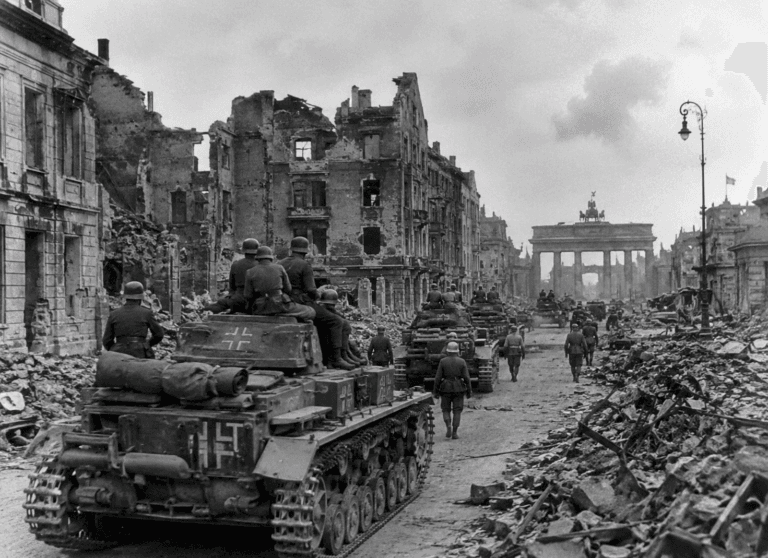
By May 1945, Soviet forces had captured Berlin, leading to Germany’s unconditional surrender.
The Pacific Theatre
While much of the world’s attention focused on Europe, an equally intense struggle was unfolding across the Pacific Ocean and Asia. The Pacific Theatre covered a vast area stretching from China and Southeast Asia to remote islands scattered across the Pacific.
Japan sought to build a powerful empire by securing access to natural resources and expanding its influence throughout the region. By the early 1940s, Japanese forces had occupied large parts of China and launched military campaigns across Southeast Asia.
The Attack on Pearl Harbor
The attack damaged or destroyed numerous American ships and aircraft and killed more than 2,400 Americans. The following day, the United States declared war on Japan, transforming the conflict into a truly global war.
Island-Hopping Campaign
As the war progressed, Allied forces adopted a strategy known as island hopping.
Rather than attacking every Japanese-held position, Allied commanders targeted strategically important islands, allowing them to move closer to Japan while bypassing heavily defended strongholds.
Major campaigns included:
- Guadalcanal
- Saipan
- Iwo Jima
- Okinawa
These battles were often fought under extremely difficult conditions and resulted in heavy casualties on both sides.
The End of the Pacific War
By 1945, Japan’s military position had deteriorated significantly.
American naval forces dominated the Pacific, Allied bombing campaigns devastated Japanese cities, and Japan faced severe shortages of fuel and supplies.
The war ultimately ended after the atomic bombings of Hiroshima and Nagasaki and the Soviet Union’s declaration of war against Japan.
Military Technology and Innovation
World War II accelerated technological development at an unprecedented pace.
Many innovations introduced during the conflict continue to influence military and civilian life today.
Tanks
Armored warfare became one of the defining features of the war.
Notable tanks included:
| Country | Tank |
|---|---|
| Germany | Tiger I |
| Germany | Panther |
| Soviet Union | T-34 |
| United States | M4 Sherman |
| United Kingdom | Churchill Tank |
The Soviet T-34 is often regarded as one of the most effective tanks of the war due to its balance of mobility, armor, and firepower.
Aircraft
Air power played a crucial role throughout the conflict.
Famous aircraft included:
- Supermarine Spitfire
- P-51 Mustang
- B-17 Flying Fortress
- Mitsubishi A6M Zero
- Messerschmitt Bf 109
Strategic bombing campaigns demonstrated the growing importance of air superiority in modern warfare.
Radar Technology
Radar helped detect incoming aircraft and naval vessels before they could be seen visually.
Britain’s radar network played a critical role during the Battle of Britain and helped offset Germany’s numerical advantages.
Naval Warfare
Aircraft carriers emerged as the dominant force in naval combat.
The battles of Coral Sea and Midway demonstrated that naval engagements could be decided by aircraft launched hundreds of miles away from enemy ships.
Codebreaking
Intelligence became a decisive factor during the war.
Allied codebreakers successfully deciphered German Enigma communications and Japanese naval codes, providing valuable information that influenced major military operations.
How World War II Ended
By 1945, the Axis Powers were facing defeat on multiple fronts.
Germany’s Surrender
In the west, Allied forces advanced through France and into Germany.
In the east, Soviet forces pushed toward Berlin after a series of major victories.
As Soviet troops entered the German capital, Adolf Hitler committed suicide on April 30, 1945.
Germany formally surrendered on May 8, 1945, a date celebrated as Victory in Europe Day (VE Day).
The Atomic Bombings
Although Germany had been defeated, Japan continued fighting.
The United States developed the world’s first nuclear weapons through the Manhattan Project.
On August 6, 1945, an atomic bomb was dropped on Hiroshima.
Three days later, a second bomb was dropped on Nagasaki.
The bombings caused massive destruction and loss of life.
Japan’s Surrender
Faced with devastating attacks and the Soviet invasion of Manchuria, Japan agreed to surrender.
On September 2, 1945, Japanese representatives formally signed the surrender documents aboard the USS Missouri.
This event officially ended World War II.
Impact of World War II
The consequences of World War II extended far beyond the battlefield.
Human Cost
World War II remains the deadliest conflict in human history.
Estimates suggest that between 70 and 85 million people died during the war.
The casualties included:
- Military personnel
- Civilians
- Victims of genocide
- Prisoners of war
The Holocaust alone resulted in the murder of approximately six million Jews, alongside millions of other victims persecuted by the regime.
Economic Consequences
Large sections of Europe and Asia were left devastated.
Cities such as Warsaw, Berlin, Hiroshima, and Manila suffered extensive destruction.
Rebuilding efforts required enormous investments and international cooperation.
Political Changes
The war dramatically altered the balance of power.
The United States and Soviet Union emerged as global superpowers, leading to decades of Cold War rivalry.
European colonial empires also began to decline as independence movements gained momentum across Africa and Asia.
Creation of the United Nations
Determined to prevent another global conflict, world leaders established the United Nations in 1945.
The organization was designed to promote international cooperation, maintain peace, and provide a forum for resolving disputes.
Today, the United Nations remains one of the most important international institutions in the world.
Interesting World War II Facts
| Fact | Detail |
|---|---|
| Largest War in History | More than 100 million people served in military forces |
| Longest Battle | Battle of the Atlantic lasted nearly the entire war |
| Deadliest Battle | Battle of Stalingrad |
| Largest Amphibious Landing | D-Day, June 1944 |
| First Nuclear Weapons Used in War | Hiroshima and Nagasaki |
| Most Decorated American Soldier | Audie Murphy |
| Largest Tank Battle | Battle of Kursk |
| First Jet Fighters | Introduced during WWII |
| Most Casualties | Soviet Union |
| Official End of War | September 2, 1945 |
Frequently Asked Questions
What caused World War II?
The war was caused by a combination of factors including the Treaty of Versailles, economic instability, the rise of Adolf Hitler, territorial expansion, and the failure of international diplomacy.
Who started World War II?
Germany’s invasion of Poland on September 1, 1939, triggered the start of World War II in Europe.
Who won World War II?
The Allied Powers, led by the United States, United Kingdom, Soviet Union, China, and other nations, defeated the Axis Powers.
When did World War II start?
World War II began on September 1, 1939.
When did World War II end?
The war officially ended on September 2, 1945, following Japan’s surrender.
How many people died in World War II?
Historians estimate that between 70 and 85 million people died during the conflict.
What were the Axis Powers?
The principal Axis Powers were Germany, Italy, and Japan.
What were the Allied Powers?
The main Allied Powers included the United Kingdom, United States, Soviet Union, China, and France.
What was D-Day?
D-Day was the Allied invasion of Normandy on June 6, 1944, which helped liberate Western Europe from occupation.
Why is World War II important today?
The war reshaped international politics, accelerated technological development, led to the creation of the United Nations, and continues to influence global affairs.
Key Takeaways
- World War II lasted from 1939 to 1945.
- Germany’s invasion of Poland triggered the conflict.
- The war was fought between the Axis and Allied powers.
- More than 70 million people lost their lives.
- Major turning points included Midway, Stalingrad, and D-Day.
- The Pacific and European theatres were the war’s primary battlefronts.
- Technological innovations transformed modern warfare.
- Germany surrendered in May 1945.
- Japan surrendered in September 1945.
- The war led to the creation of the United Nations and reshaped the modern world.
Conclusion
World War II was a defining event of the twentieth century. It transformed nations, redrew borders, accelerated technological progress, and altered the course of global history. The conflict demonstrated both humanity’s capacity for destruction and its ability to rebuild in the aftermath of catastrophe.
Leave a Reply