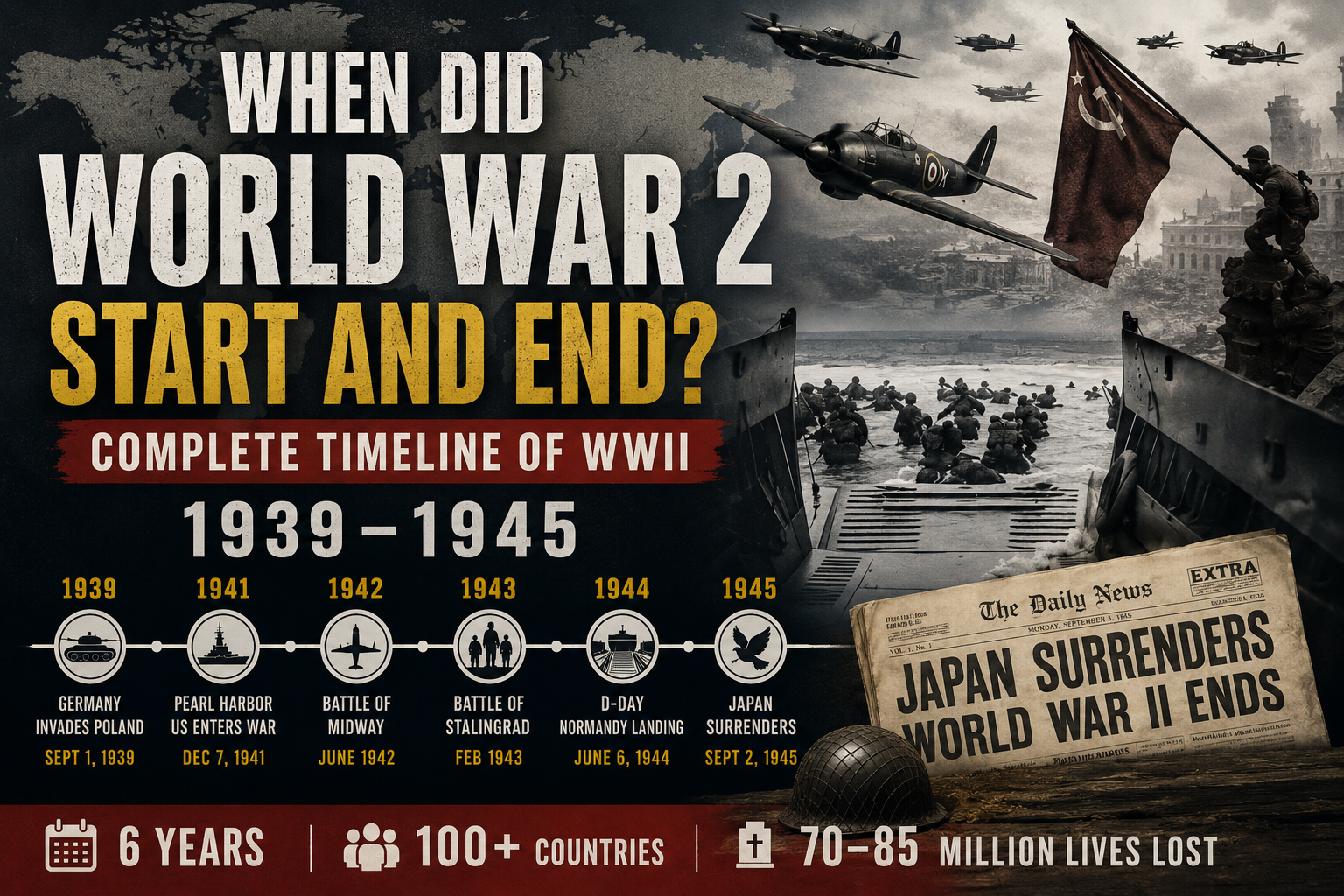
When Did World War II Start and End? World War II officially began on September 1, 1939, when Germany invaded Poland, and ended on September 2, 1945, when Japan formally surrendered aboard the USS Missouri. Lasting almost six years, the conflict became the deadliest war in human history, involving more than 100 million military personnel from over 30 countries and resulting in an estimated 70–85 million deaths.
The war transformed the global balance of power, accelerated technological innovation, reshaped national borders, and led to the creation of international institutions that continue to influence world affairs today.
In this guide, we’ll explore exactly when World War II started and ended, why it began, the major events that defined the conflict, and how the war changed the modern world.
When Did World War II Start and End?
World War II officially began on September 1, 1939, when German forces crossed the Polish border and launched a coordinated military invasion.
The attack was part of Adolf Hitler’s plan to expand German territory and overturn the post-World War I order established by the Treaty of Versailles.
Germany employed a new military strategy known as Blitzkrieg, or “lightning war,” which combined tanks, aircraft, and infantry in fast-moving attacks designed to overwhelm enemy defenses before they could organize resistance.
Within days, Poland found itself under attack from both Germany and the Soviet Union, which had secretly agreed to divide the country under the Molotov-Ribbentrop Pact.
Britain and France Declare War
Britain and France had pledged to defend Poland against German aggression.
When Germany refused to withdraw, both countries declared war on Germany on September 3, 1939.
This transformed a regional invasion into a global conflict that would eventually spread across Europe, Africa, Asia, and the Pacific.
Key Start Date
| Event | Date |
|---|---|
| Germany Invades Poland | September 1, 1939 |
| Britain Declares War | September 3, 1939 |
| France Declares War | September 3, 1939 |
| Official Beginning of WWII | September 1939 |
When Did World War II Start and End?
The outbreak of war was not caused by a single event. Instead, it resulted from years of political instability, economic hardship, and aggressive expansion by authoritarian regimes.
Treaty of Versailles
The Treaty of Versailles, signed after World War I, imposed harsh penalties on Germany.
Many Germans viewed the treaty as humiliating, creating widespread resentment and political instability.
Rise of Adolf Hitler
Hitler came to power in 1933 and promised to restore Germany’s strength.
He rebuilt the military, violated international agreements, and pursued territorial expansion throughout Europe.
Expansion of Germany
Before invading Poland, Germany had already:
- Remilitarized the Rhineland
- Annexed Austria
- Occupied Czechoslovakia
- Expanded military production
These actions increased tensions across Europe.
Failure of Diplomacy
Attempts to prevent war through negotiation and appeasement failed.
European leaders hoped concessions would satisfy Hitler’s demands, but instead they encouraged further aggression.
When Did World War II Start and End: World War II Timeline (1939–1945)
The war unfolded through a series of major campaigns and turning points.
1939
- Germany invades Poland
- Britain and France declare war
- Soviet Union invades eastern Poland
1940
- Germany invades Denmark and Norway
- Germany conquers France
- Battle of Britain begins
1941
- Germany invades the Soviet Union
- Japan attacks Pearl Harbor
- United States enters the war
1942
- Battle of Midway
- Battle of Stalingrad begins
- Allied victories in North Africa
1943
- Germany defeated at Stalingrad
- Italy surrenders
- Allied invasion of Italy
1944
- D-Day landings in Normandy
- Liberation of Paris
- Battle of the Bulge
1945
- Soviet forces capture Berlin
- Germany surrenders
- Atomic bombings of Hiroshima and Nagasaki
- Japan surrenders
Complete WWII Timeline Table
| Year | Major Event |
|---|---|
| 1939 | Invasion of Poland |
| 1940 | Fall of France |
| 1940 | Battle of Britain |
| 1941 | Operation Barbarossa |
| 1941 | Pearl Harbor |
| 1942 | Battle of Midway |
| 1942–43 | Battle of Stalingrad |
| 1944 | D-Day |
| 1944 | Battle of the Bulge |
| 1945 | Germany Surrenders |
| 1945 | Japan Surrenders |
When Did World War II End in Europe?
The war in Europe ended on May 8, 1945, known as Victory in Europe Day (VE Day).
By early 1945, Allied forces were advancing from the west while Soviet forces approached Germany from the east.
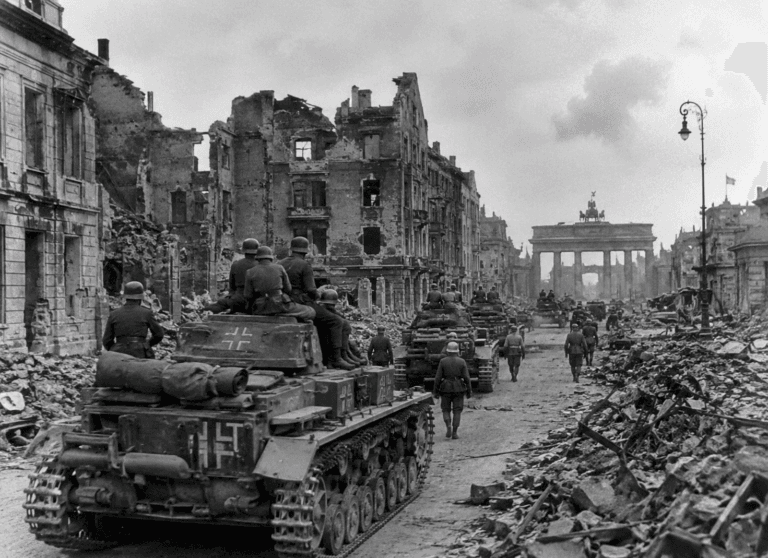
Fall of Berlin
Berlin became the final battleground of Germany.
The city was surrounded by Soviet forces, and intense fighting occurred street by street.
On April 30, 1945, Adolf Hitler committed suicide in his underground bunker.
Germany’s Surrender
German military leaders recognized that further resistance was impossible.
Germany signed an unconditional surrender agreement on May 7, 1945, which took effect the following day.
Important European End Dates
| Event | Date |
|---|---|
| Hitler’s Death | April 30, 1945 |
| Germany Signs Surrender | May 7, 1945 |
| VE Day | May 8, 1945 |
When Did World War II End in the Pacific?
Although Germany had surrendered, the war continued in Asia and the Pacific.
Japan remained determined to fight despite suffering devastating losses.
Hiroshima
On August 6, 1945, the United States dropped an atomic bomb on Hiroshima.
The explosion destroyed much of the city and caused massive casualties.
Nagasaki
A second atomic bomb was dropped on Nagasaki on August 9, 1945.
Soviet Entry into the War
The Soviet Union declared war on Japan and launched a major offensive in Manchuria.
This removed any remaining hope that Japan could negotiate a favorable settlement.
Japan’s Surrender
Emperor Hirohito announced Japan’s surrender on August 15, 1945.
The formal surrender ceremony took place on September 2, 1945, aboard the USS Missouri in Tokyo Bay.
This date marks the official end of World War II.
How Long Did World War II Last?
World War II lasted:
- 6 years
- 1 day
- From September 1, 1939, to September 2, 1945
The conflict spanned multiple continents and involved more nations than any previous war.
By the Numbers
| Statistic | Value |
|---|---|
| Duration | 6 Years |
| Countries Involved | 30+ |
| Military Personnel | 100+ Million |
| Estimated Deaths | 70–85 Million |
| Major Theatres | Europe, Pacific, Africa |
Why Are the Start and End Dates Important?
The beginning and end of World War II mark two of the most significant moments in modern history.
The invasion of Poland demonstrated the failure of diplomacy and collective security.
The surrender of Japan signaled the beginning of a new era shaped by:
- The United Nations
- Nuclear weapons
- The Cold War
- Decolonization movements
- American and Soviet superpower rivalry
Many of today’s international institutions and alliances were influenced by lessons learned during the war.
Interesting Facts About World War II Dates
- The war began on a Friday, September 1, 1939.
- Germany surrendered 2,077 days after invading Poland.
- The Pacific War continued nearly four months after Germany’s defeat.
- VE Day and VJ Day are celebrated separately because the war ended at different times in Europe and Asia.
- The USS Missouri remains one of the most famous battleships in history because Japan signed its surrender documents aboard the vessel.
Frequently Asked Questions
When did World War II start?
World War II started on September 1, 1939, when Germany invaded Poland.
When did World War II end?
The war officially ended on September 2, 1945, after Japan’s formal surrender.
How many years did World War II last?
The conflict lasted approximately six years.
What event started World War II?
Germany’s invasion of Poland triggered the beginning of the war.
What event ended World War 2?
Japan’s formal surrender aboard the USS Missouri ended the war.
When did Germany surrender?
Germany surrendered on May 7, 1945, with the surrender taking effect on May 8.
When did Japan surrender?
Japan announced its surrender on August 15, 1945, and formally signed surrender documents on September 2.
What happened between VE Day and VJ Day?
Fighting continued in the Pacific against Japan even after Germany’s surrender.
Which battle marked the turning point in Europe?
Many historians consider the Battle of Stalingrad a major turning point in the European Theatre.
Which battle marked the turning point in the Pacific?
The Battle of Midway is widely regarded as the turning point of the Pacific War.
Key Takeaways
- World War II began on September 1, 1939.
- Germany’s invasion of Poland triggered the conflict.
- Britain and France declared war on Germany on September 3, 1939.
- The war lasted approximately six years.
- Germany surrendered on May 8, 1945.
- Japan formally surrendered on September 2, 1945.
- The conflict involved more than 100 million military personnel.
- An estimated 70–85 million people died during the war.
- The war reshaped global politics and international relations.
- The United Nations was established in the aftermath of the conflict.
Leave a Reply