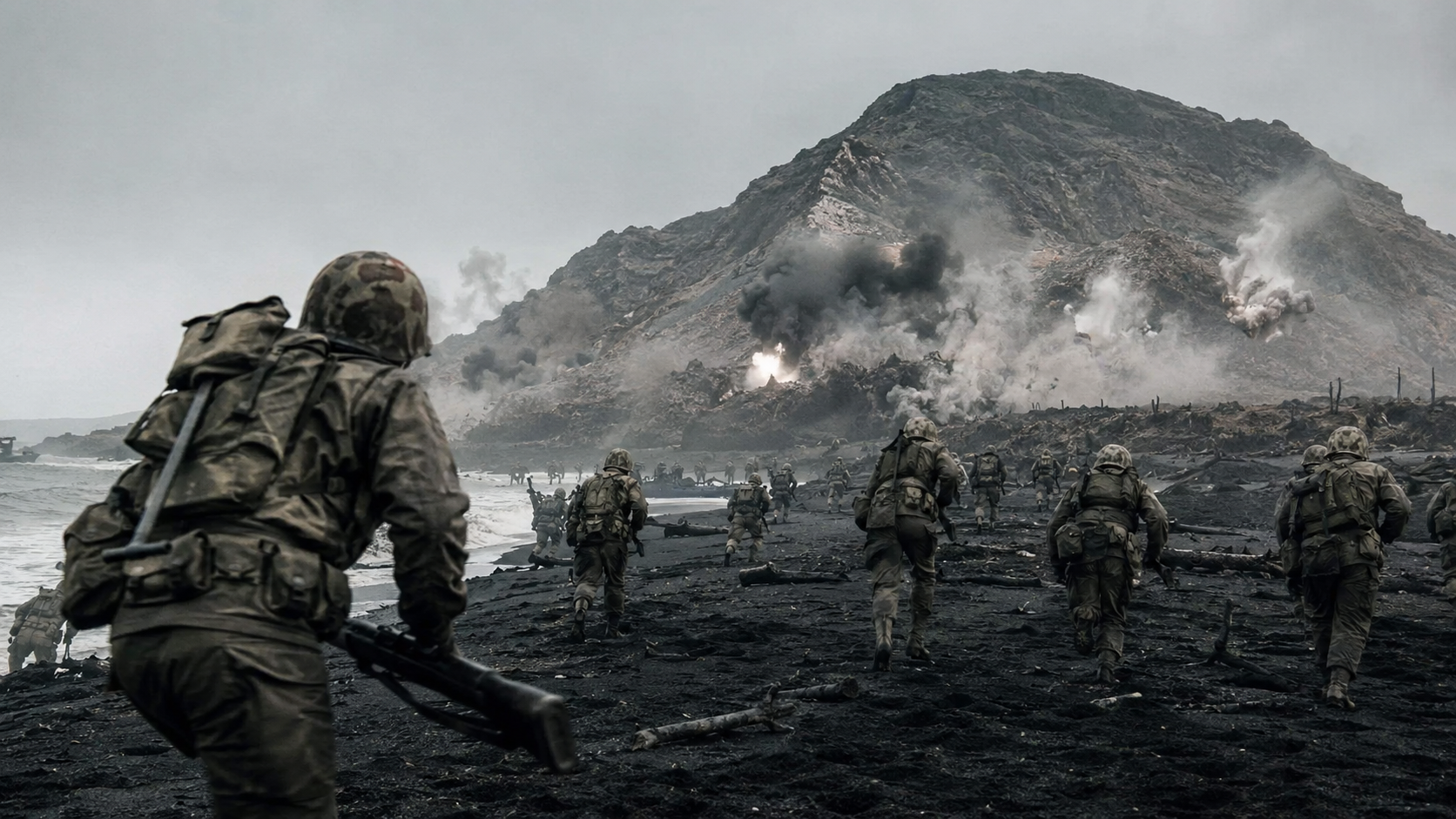
The Battle of Iwo Jima was one of the most intense and costly battles of World War II. Fought between the United States and Japan from February 19 to March 26, 1945, the battle centered on a small volcanic island located roughly halfway between the Mariana Islands and mainland Japan.
Although Iwo Jima covered only eight square miles, it held enormous strategic value. The island provided airfields that could support bombing missions against Japan and serve as emergency landing sites for damaged American aircraft returning from combat operations.
The battle became famous for the determination of both sides, the extraordinary casualty rates, and the iconic photograph of U.S. Marines raising the American flag atop Mount Suribachi.
Quick Facts About the Battle of Iwo Jima
| Detail | Information |
|---|---|
| Dates | February 19 – March 26, 1945 |
| Location | Iwo Jima, Pacific Ocean |
| Belligerents | United States vs Japan |
| Outcome | American Victory |
| Significance | Strategic base for operations against Japan |
Where Is Iwo Jima?
Iwo Jima is a small volcanic island located approximately 750 miles south of Tokyo.
Its location made it strategically important because Japanese aircraft based there could intercept American bombers flying toward Japan.
Capturing the island would help protect Allied air operations and provide a forward base closer to the Japanese mainland.
Why Was Iwo Jima Important?
By early 1945, Allied forces had pushed steadily across the Pacific through a strategy known as island hopping.
American commanders believed capturing Iwo Jima would provide several advantages:
- Emergency landing fields for damaged bombers
- Fighter escort bases for bombing missions
- Removal of Japanese radar warning stations
- A staging area for future operations
Japan’s Defensive Strategy
Unlike earlier battles in the Pacific, Japanese commander General Tadamichi Kuribayashi adopted a new defensive strategy.
Instead of defending beaches directly, he constructed an extensive underground network.
The Tunnel System
Japanese forces built:
- More than 11 miles of tunnels
- Underground bunkers
- Hidden artillery positions
- Reinforced command centers
This defensive system allowed Japanese troops to survive bombardments and continue fighting even after Allied landings.
The Invasion Begins
February 19, 1945
Thousands of U.S. Marines landed on Iwo Jima following days of naval and aerial bombardment.
Initially, resistance seemed lighter than expected.
However, Japanese defenders soon opened fire from concealed positions throughout the island.
The battle quickly became one of the fiercest engagements of the Pacific War.
Mount Suribachi
At the southern end of the island stood Mount Suribachi, a dormant volcanic mountain that dominated the battlefield.
Capturing it became a major objective for American forces.
The Famous Flag Raising
On February 23, 1945, U.S. Marines raised an American flag on the summit.
Photographer Joe Rosenthal captured the moment in one of the most famous photographs in history.
The image became an enduring symbol of courage and sacrifice during World War II.
Fighting Across the Island
Although Mount Suribachi was secured relatively early, the battle was far from over.
American forces continued fighting across the island’s northern sectors.
Japanese defenders used:
- Tunnels
- Caves
- Hidden machine-gun positions
- Camouflaged artillery
Every advance came at a high cost.
Casualties of the Battle
| Side | Estimated Casualties |
|---|---|
| United States | Approximately 26,000 |
| Japan | Approximately 21,000 |
Nearly all Japanese defenders were killed during the battle.
Iwo Jima remains one of the few battles where American casualties exceeded the total number of Japanese defenders.
Why Was the Battle So Difficult?
Underground Defenses
The tunnel network allowed Japanese troops to move unseen and launch surprise attacks.
Volcanic Terrain
The island’s soft volcanic ash made movement difficult for soldiers and vehicles.
Determined Resistance
Japanese defenders fought to the end rather than surrender.
Strategic Impact of Iwo Jima
After the battle, American forces used the island as a base for operations against Japan.
Emergency Landings
Thousands of damaged American bombers later landed safely on Iwo Jima.
Support for Future Operations
The island played an important role in preparations for the final stages of the Pacific War.
Interesting Facts About Iwo Jima
- The battle lasted 36 days.
- The island measures only about eight square miles.
- The famous flag-raising photograph won a Pulitzer Prize.
- Nearly all Japanese defenders were killed.
- The battle became one of the bloodiest Marine Corps operations in history.
Frequently Asked Questions
Why was Iwo Jima important?
The island provided strategic airfields closer to Japan and supported Allied bombing operations.
Who won the Battle of Iwo Jima?
The United States captured the island after more than a month of intense fighting.
Why was the battle so costly?
Japanese tunnel systems, fortified defenses, and difficult terrain created extremely challenging combat conditions.
What is Mount Suribachi?
Mount Suribachi is the volcanic mountain where U.S. Marines raised the famous American flag during the battle.
How long did the Battle of Iwo Jima last?
The battle lasted from February 19 to March 26, 1945.
Key Takeaways
- The Battle of Iwo Jima was fought from February to March 1945.
- The island held significant strategic value for Allied air operations.
- Japanese forces built extensive underground defenses.
- Mount Suribachi became the site of the iconic flag-raising photograph.
- The battle produced heavy casualties on both sides.
- Iwo Jima helped bring Allied forces closer to mainland Japan.
Conclusion
The Battle of Iwo Jima demonstrated the immense challenges of the Pacific War and the determination of both American and Japanese forces. Although fought on a tiny island, its impact was significant, providing critical support for Allied operations and contributing to the eventual defeat of Japan. Today, Iwo Jima remains one of the most studied and remembered battles of World War II.
Related Articles
- Japan in World War 2
- Battle of Midway
- Pearl Harbor Attack
- Major Battles of World War 2
- World War 2 Timeline
- Battle of Okinawa
- Pacific Theater of World War II
19 February 1945
United States Marines landed on Iwo Jima, beginning one of the Pacific War’s fiercest and bloodiest island battles.
Hidden Defenses
Japanese forces defended the island through an extensive network of underground tunnels, bunkers, and fortified positions.
Iconic Moment
On 23 February 1945, Marines raised the American flag atop Mount Suribachi, creating one of the most famous photographs of World War II.
26 March 1945
Organized resistance ended after more than five weeks of intense fighting, with heavy casualties on both sides.
Strategic Value
Iwo Jima became an emergency landing base for damaged B-29 bombers, supporting later air operations against Japan’s home islands.
Decode this battlefield
Iwo Jima cipher
The famous flag-raising photograph was taken on top of Mount _________.
Mount Suribachi, a dormant volcano at the island’s southern tip, became the site of one of the most iconic photographs in military history after U.S. Marines raised the American flag there on 23 February 1945.
Decoded
Case solved. Continue exploring the pivotal battles that shaped the Pacific War.
Leave a Reply